
China’s Belt and Road Initiative in the South Caucasus: A Region Moving from the Margins to the Spotlight
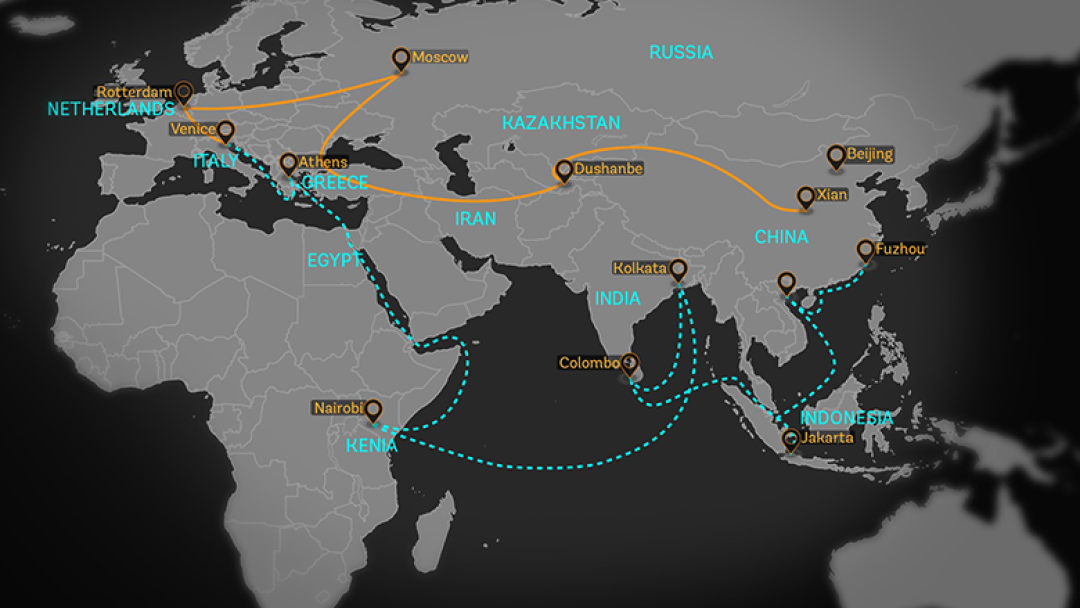
Source: World Bank
When Chinese President Xi Jinping announced the Belt and Road Initiative (BRI) in Kazakhstan in 2013, he outlined an ambitious plan to reshape global connectivity. Originally called One Belt, One Road, the initiative envisioned two major components: the “Belt,” a vast overland network of six economic corridors linking China to Europe through Central Asia and beyond, and the “Road,” a maritime route stretching across the Indian Ocean, the Red Sea, and the Mediterranean. Together, they were designed to create a web of roads, railways, ports, and pipelines that would more closely bind China to its partners.
Over the past decade, the BRI has become a cornerstone of Beijing’s foreign policy. By mid-2023, China had signed more than 200 BRI cooperation agreements with over 150 countries and 30 international organizations, with cumulative trade between China and its BRI partners reaching $19.1 trillion. The initiative has also become more flexible, adapting to shifting geopolitics. One of those shifts is now bringing the South Caucasus into sharper focus.
Why the South Caucasus Matters Now
For years, the South Caucasus was peripheral to Beijing’s vision. The spotlight was on Central Asia and Russia, with corridors like the China–Mongolia–Russia route and the New Eurasian Land Bridge carrying much of the traffic. But Russia’s war against Ukraine has changed the calculus. The conflict has disrupted traditional trade flows, cast doubt on Moscow-centered routes, and prompted China to urgently seek alternatives to maintain secure access to Europe.
This is where the China–Central Asia–West Asia Economic Corridor (CCAWEC) comes in. Passing through Central Asia, the Caspian Sea, and into the South Caucasus, the corridor offers a land-sea hybrid link to Europe that completely bypasses Russian territory. Within it, the Middle Corridor (Trans-Caspian International Transport Route, or TITR) has emerged as the most viable option, connecting China to Europe via Kazakhstan, Azerbaijan, Georgia, and Türkiye.
For the South Caucasus, this shift is a geopolitical windfall. Each of the three countries—Azerbaijan, Georgia, and Armenia—is trying to reposition itself within this evolving map of Eurasian connectivity, though with very different degrees of success.
Azerbaijan: The Emerging Regional Node
Among the three, Azerbaijan has been the most proactive and successful in capitalizing on the BRI. Baku's geography gives it a natural advantage: it sits astride the Caspian Sea, connecting eastward to Central Asia and westward to Georgia and Türkiye. Over the past decade, Azerbaijan has invested heavily in its role as a transit hub. Key projects include the Baku–Tbilisi–Kars (BTK) railway, which links Azerbaijan directly with Türkiye and, by extension, Europe. The country is also central to the TITR, a multimodal corridor that moves goods across the Caspian by ferry and then onward by rail. Other relevant initiatives include the Lapis-Lazuli corridor, linking Afghanistan to Turkey via Turkmenistan, the Caspian Sea, Azerbaijan, and Georgia.
Baku’s political strategy has been to balance carefully between major powers—the EU, Russia, Iran, Türkiye, and now China—while presenting itself as a reliable energy and logistics partner. In 2019, Azerbaijan and China signed contracts worth $821 million at the second Belt and Road Forum, covering industrial cooperation. By 2023, bilateral trade had reached $3.1 billion, up 43.5 percent year-on-year, with China becoming Azerbaijan’s second-largest source of imports, for the first time overtaking Türkiye. In April 2025, Azerbaijan elevated its ties with China to a comprehensive strategic partnership, accompanied by a new multimodal transport agreement designed to smooth customs and cargo flows along the TITR.
Beijing is also extending its influence into Azerbaijan’s energy transition. Chinese contractors are building the country’s first large-scale renewable energy plants, and Chinese firms are exploring investments in digital infrastructure. Azerbaijan is thus not just a corridor but increasingly a multi-sector partner in China’s Eurasian strategy.
Georgia: The Black Sea Gateway
Georgia's strategic importance to the Belt and Road Initiative is rooted in a singular geographic fact: it is the vital Black Sea outlet of the Middle Corridor. Lacking the Caspian resources of its neighbor Azerbaijan, Georgia's value to Beijing's vision lies not in what it exports but in its indispensable role as the final terrestrial artery for moving goods westward toward Europe. Its territory serves as a crucial gateway, a role it is working to fully leverage.
Tbilisi was the first South Caucasus state to sign a Silk Road memorandum with Beijing, in 2015, followed by Armenia and then Azerbaijan. Since then, Georgia has deepened its cooperation, signing a strategic partnership with China in July 2023. A Chinese consortium is now involved in reviving the long-stalled Anaklia deep-sea port project, which could transform Georgia into a true Black Sea hub by accommodating larger cargo ships and boosting container flows.
China’s interest also extends to Georgia’s road and rail infrastructure. The East–West Highway, coupled with the BTK railway, anchors the Georgian segment of the Middle Corridor. These projects shorten the transport distance between China and Europe and bypass Russian territory, making Georgia strategically attractive to Beijing.
However, the benefits have so far been uneven. Trade is growing but remains imbalanced. Beijing’s involvement has largely been confined to transit infrastructure, and Chinese capital has not yet translated into broader investment in Georgia’s economy. Still, the symbolism of the strategic partnership and the Anaklia project indicates that Beijing sees Georgia as its gateway to Europe in its regional strategy.
Armenia: An Outsider Seeking to Fit In
For most of the past decade, Armenia has been the outlier in the South Caucasus BRI story. Despite signing a Silk Road memorandum in 2015, no official BRI corridor has ever passed through Armenian territory. Closed borders with Türkiye and Azerbaijan left it dependent on Georgia and Iran, while its underdeveloped infrastructure kept it off Beijing’s main connectivity map.
But the geopolitical tide is shifting. On August 8, 2025, Armenia and Azerbaijan signed a Washington-backed declaration that not only advanced reconciliation but also launched the TRIPP project—a new east-west transit route through Armenia’s Syunik region. Unlike the “Zangezur Corridor” envisioned in the 2020 ceasefire deal, which would have given Azerbaijan and Russia control over a secure passage, TRIPP is explicitly designed to remain under Armenian jurisdiction and sovereignty. Its operation will be overseen by a U.S.-backed corporate entity, ensuring international guarantees and limiting the leverage of both Baku and Moscow.
For Yerevan, TRIPP could be transformative. It creates a functional east-west passage linking Azerbaijan to Nakhchivan and Türkiye while embedding Armenia into regional transit flows for the first time since its independence. Crucially, it allows Armenia to participate without surrendering sovereignty, reframing connectivity as a tool of national resilience rather than vulnerability.
From Beijing’s perspective, TRIPP could offer an additional layer of flexibility within the China–Central Asia–West Asia Economic Corridor. Combined with Armenia’s North–South Road Corridor (NSRC)—the long-delayed but strategically vital highway linking Iran to Georgia—TRIPP positions Armenia as a potential bridge between the east-west and north-south axes. This would give China options beyond the Azerbaijan–Georgia–Türkiye route, reducing Beijing’s dependence on Ankara and Baku while adding another balancing tool to its regional diplomacy.
Still, the challenges are real. Financing for the NSRC remains scarce, Armenia’s mountainous terrain inflates costs, and political uncertainties could still undermine the peace process. Trade data also reflects the gap between political ambition and economic reality: in the first half of 2025, Armenia’s exports to China fell by nearly 60 percent despite the announcement of a new strategic partnership with Beijing.
Yet, if TRIPP is implemented under U.S. oversight and the Crossroads of Peace initiative moves forward, Armenia may finally gain the connectivity it has long lacked. Instead of being the outlier of the South Caucasus, it could become a secondary but meaningful node in the BRI—not the main artery like Azerbaijan, nor the natural gateway like Georgia, but a complementary passage that enhances Beijing’s strategic depth while giving Yerevan a long-sought place on the map of Eurasian trade.
Contributed by Asya Gasparyan, a PhD Researcher at the School of International Studies, University of Trento, Italy. Additionally, she holds the position of Research Fellow at the Regional Studies Center, Yerevan, Armenia.