
Dissolution of the OSCE Minsk Group: A Coercive Peace Deal or a Failed Platform?
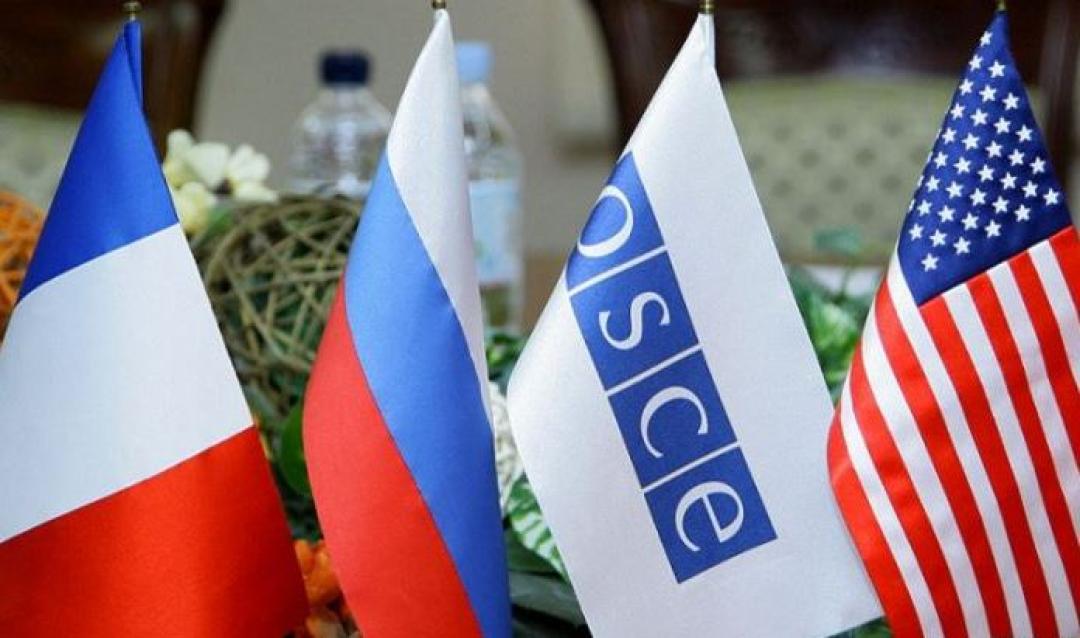
As is already known, the OSCE Minsk Group, which has been the axis of the Karabakh conflict settlement for over 30 years, was dissolved on September 1, 2025. This followed an OSCE Ministerial Council decision which was preceded by the August 8 Joint Appeal to dissolve the Minsk Group, signed in Washington by Armenian Prime Minister Nikol Pashinyan and Azerbaijani President Ilham Aliyev, and backed by U.S. President Donald Trump. Earlier, Azerbaijani President Ilham Aliyev had outlined the dissolution of the Minsk Group as a precondition for signing a peace agreement with Armenia.
Chronology of the Minsk Group and its Efficiency Index
On March 24, 1992, during the Budapest Summit of the CSCE (later renamed the OSCE in December 1994), the Council of Ministers established the Minsk Conference to support the peaceful settlement of the Nagorno-Karabakh conflict through negotiations. After a short period, the Minsk Conference evolved into the Minsk Group, retaining the same goals and mandate.
Initially, Sweden chaired the Group. In January 1995, Russia was elected co-chair, as it was through its mediation that a ceasefire was established in May 1994. In April 1995, Finland replaced Sweden. In January 1997, France took over from Finland, and on February 14, the United States became the third co-chair country. Subsequently, the entire process was led by the co-chairs of these three countries: Russia, the United States, and France, although six more countries were members of the Minsk Group.
The OSCE Minsk Group had factually suspended its activities due to circumstances that arose after the 44-day Second Karabakh War in 2020. With the outbreak of the Russian-Ukrainian war, the Minsk Group members—the Russian, American, and French co-chairs—no longer met.
A key episode in the activities of the Minsk Group Co-Chairs occurred in November 2007, when they presented a new version of the negotiating document to the Foreign Ministers of Armenia and Azerbaijan. This document, the so-called "Madrid Principles," for the first time in the negotiation process, stated that the conflict should be resolved based on one of the fundamental principles of international law: the right to self-determination. Another offer was put forward in 2015, known as the "Lavrov Plan," which proposed linking the deployment of Russian armed forces in Nagorno-Karabakh with the gradual withdrawal of Armenian troops from adjacent territories and the provision of a "temporary status" for an indefinite period.
Despite a number of settlement options presented by the co-chairs, the conflicting parties never reached an agreement on them. Some international political scientists and diplomats have argued that “the mediation process has been severely hampered by the changing power relationships among the parties to the conflict and among external parties that have constituted the primary mediation body” (Hopmann, 2013). Others see it as “a consequence of a shift in the military balance of power, consistently fueled by Russia’s distribution of advanced offensive arms to Azerbaijan and the evident impracticability of the Minsk Group” (Abrahamyan, 2016).
Richard Hoagland, who served as a U.S. co-chair of the OSCE Minsk Group in 2017, claimed, “Russia is by far the best placed to bring a conclusion to these [frozen conflicts], but it chooses not to do so. The reason is that a resolution would enable each country to feel free enough to leave the den of the Big Bear to the north and look for other partners and multi-lateral alliances".
Response of Co-chairing Countries and Parties to the Dissolution
The decision to dissolve the Minsk Group, initiated with U.S. mediation, was supported by the co-chair countries. France considered it a decisive step towards the normalization of relations, while Russia assessed the move as justified.
Prior to the de facto dissolution of the Minsk Group in September, Armenian Prime Minister Pashinyan had reiterated Armenia's position that they would sign the appeal for its dissolution after the signing of a peace agreement, or simultaneously. However, the course of events showed that the appeal was signed by Pashinyan during the initialing of an agreement in Washington on August 8, not alongside a final peace agreement. While the Armenian authorities had been relatively discreet about the Minsk Group's activities before its dissolution, Nikol Pashinyan later made highly critical comments about its usefulness, showing full consensus with the Azerbaijani position on this matter. It should be remembered that Ilham Aliyev fiercely criticized the activities of the OSCE Minsk Group, calling the platform ineffective.
Following the decision to dissolve the Minsk Group, the Azerbaijani Foreign Ministry released a statement declaring that "all decisions previously adopted within the OSCE framework regarding the former Armenia-Azerbaijan conflict have been declared null and void".
Armenian Policy Experts’ and Politicians’ Views
In a conversation with Caucasus Watch, a number of representatives from Armenian political circles, especially from the opposition, expressed their concern regarding the dissolution of the Minsk Group, which, they believe, may cause numerous problems for Armenia in the future.
Former Prime Minister of Armenia and current leader of the Freedom Party, Hrant Bagratyan, is convinced that the dissolution of the Minsk Group utterly buries the Karabakh issue. He stated, "that group was formed to clarify the status of Karabakh: should it be independent, part of Azerbaijan, or a little bit of this, a little bit of that?". Bagratyan concludes, “The dissolution of the Minsk Group means there is no Karabakh issue because there is no Karabakh population”.
Naira Zohrabyan, a former representative to the Parliamentary Assembly of the Council of Europe (PACE) and former Chair of the Standing Committee on European Integration and the Committee on Human Rights and Public Affairs of the Armenian Parliament, believes that the OSCE Minsk Group was "the only professional and most solid mandate under which the Karabakh issue has been discussed for thirty or more years." She argues its dissolution will cause serious problems, first and foremost for the Artsakh people (Nagorno-Karabakh Armenians).
"We have the Order of November 17, 2023, of the Hague International Court of Justice, which directly obligates Azerbaijan to create legitimate, safe, and secure conditions for 'the expeditious return of displaced ethnic Armenians from Nagorno-Karabakh to their homes under an international mandate.' We have the Motion of the Swiss Parliament’s Upper House, the Council of States, titled 'Peace Forum for Nagorno-Karabakh: Enabling the Return of Armenians,' as well as the Resolution of the Belgian Federal Parliament 'to guarantee the rights and safe, unimpeded return of ethnic Armenians to Nagorno-Karabakh under international observation and security guarantees.' All of that must take place under an internationally guaranteed mandate. The question is: What is that mandate? The only mandate that could function and provide that guarantee was the OSCE Minsk Group, which unfortunately was dissolved at the behest of Aliyev,” Zohrabyan stated.
According to Zohrabyan, the dissolution may also create future problems for protecting the rights of displaced ethnic Armenians from Karabakh. "There are many issues regarding the ownership and property rights of Artsakh residents, as well as thousands of episodes of exhumations, where relatives do not know who to turn to. All those issues could have been solved under the mandate of the OSCE Minsk Group. Since the number one task for Aliyev was to fundamentally erase any legal channels related to Artsakh, a direct, clear demand was formulated before the Armenian government to apply together with Azerbaijan to dissolve the OSCE Minsk Group,” she noted.
Zohrabyan also draws attention to the fact that an excerpt from the Comprehensive and Enhanced Partnership Agreement (CEPA) referring to Nagorno-Karabakh is still posted on the official website of the European Union. That section clearly states that the Nagorno-Karabakh issue must be resolved under the mandate of the OSCE Minsk Group, upholding the three fundamental international principles of "refraining from the threat or use of force, the territorial integrity of States, and the equal rights and self-determination of peoples". "In fact, the OSCE Minsk Group has been dissolved, but it still remains on the agenda of major international centers, with the exception of the agendas of Armenia and Azerbaijan," Zohrabyan concludes.
Opposition MP Taguhi Tovmasyan, who also chaired the Armenian National Assembly's Committee on Protection of Human Rights, shares this concern. “The dissolution of the OSCE Minsk Group means closing the page on the return of Artsakh and Artsakh Armenians. It was not only a political step to close the issue but also put an end to humanitarian problems and deprived Armenia of the right to own its ethnic Armenian cultural heritage. The people of Artsakh lost the opportunity to return to their homes, also legally. This was the worst thing that could happen to Armenia,” Tovmasyan concludes.
However, some Armenian political scientists express a more optimistic view. Ruben Mehrabyan, a political expert at the Armenian Institute of International and Security Affairs and vice-chairman of the "For the Republic" party, believes the dissolution is logical. "I don't see anything negative here, especially when it comes to the tri-chairmanship, one of which is Russia. Virtually, this could be another basis for Russia to consider its interference in our regional affairs legitimate, claiming the status of a mediator. Now it's gone," he stated. "We heard the attitude of Washington, Paris, and Moscow regarding this, and at the same time, we see that both Armenia and Azerbaijan link their future with the United States... I only see the positive," the political scientist summed up.
Conclusion
It follows that due to a combination of objective and subjective reasons, the OSCE Minsk Group could not have a significant impact, and the co-chairs were unable to work effectively to galvanize the mediation process. The group's activity was already problematic during and after the 2020 war. Prior to that, while the parties accepted the platform and discussed its proposals, ultimately, the decision-makers were not the co-chairs, but the parties themselves.
This was, in a way, beneficial for the co-chairing countries, which may be why they unanimously supported the Group's closure. Dissolution at the request of Armenia and Azerbaijan absolved the OSCE of having to answer difficult questions about the Group's purpose and its success or failure.
Against the backdrop of recent events, much can be said and criticized about the OSCE Minsk Group. Yet, it represented an international consensus on the conflict, and it only ceased to function when the world order began to change and previous formats started to collapse. For better or worse, it had a certain international mediation role, maintaining the permanence of negotiations in the region.
It is also noteworthy that while Azerbaijan has always expressed dissatisfaction with the OSCE Minsk Group, similar assessments from Armenia are a surprise, although they fit the regional logic: if the parties agree to dissolve the platform, they must declare it was ineffective.
Even though the only international format with a legal mandate for the Karabakh issue has been closed at Azerbaijan's request and with Armenia's tacit agreement, there remains a hope that the West, acting from a position of human rights protection, cannot ignore the rights of 150,000 people displaced from their homes. There is an imperative to create new institutional mechanisms to solve these issues.
Contributed by Anna Vardanyan, a political journalist-researcher from Armenia based in Yerevan. Her 18 years of professional and academic research career closely relates to international relations, political science and security policy topics within the Eastern Europe and Caucasus region overall.
Insights,
Politics,
Armenia |
Russia, Nikol Pashinyan, Ilham Aliyev, France, Donald Trump, OSCE Minsk Group, Armenia-Azerbaijan Relations