
Iran and BRICS+: Influence Without Integration
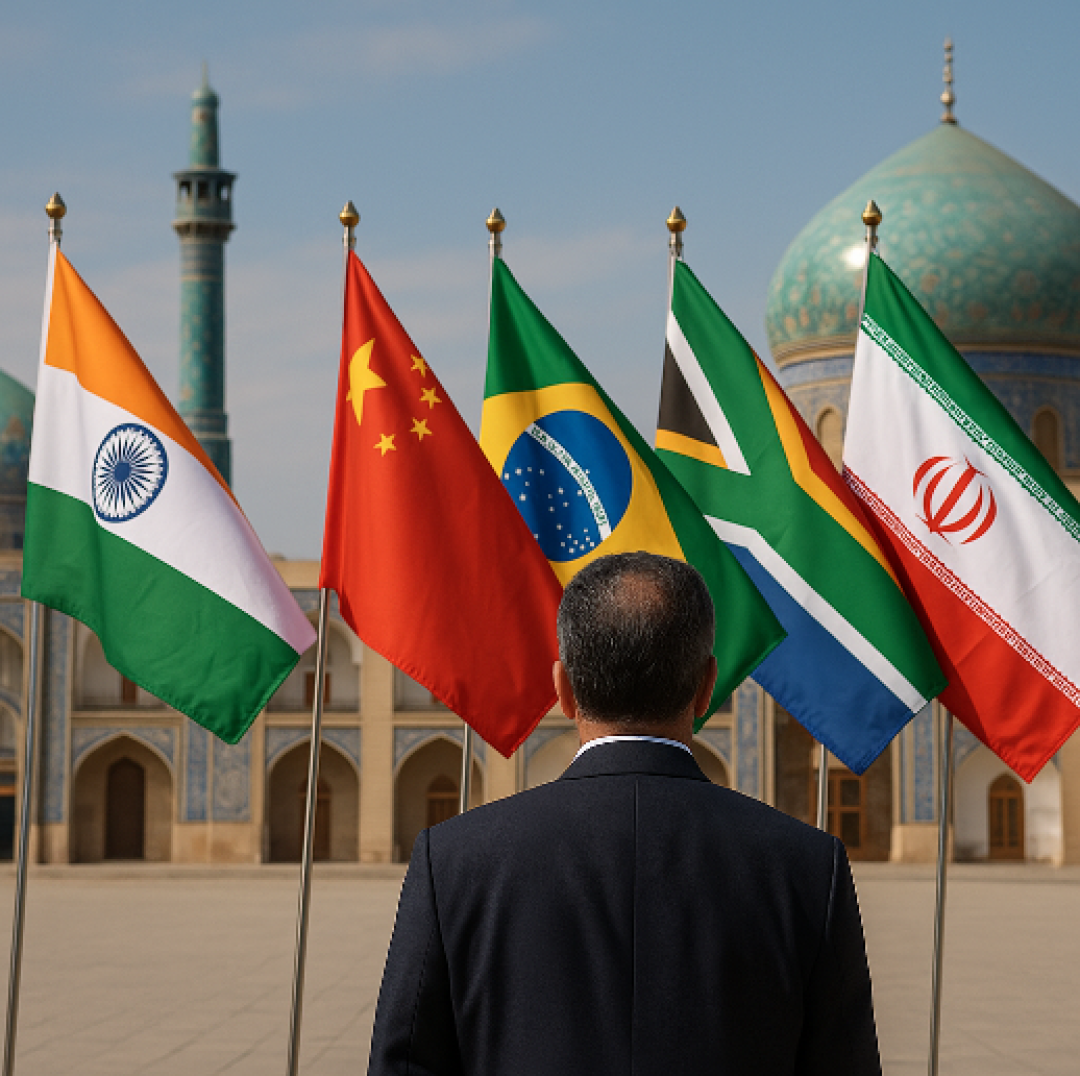
Iran’s entry into BRICS+ signals its intent to expand influence through multipolar platforms, even as sanctions continue to constrain its economy. While immediate gains remain limited, infrastructure projects like the International North–South Transport Corridor (INSTC) could reshape regional connectivity. For the South Caucasus, and particularly Armenia, the challenge is to turn participation in these frameworks into tangible opportunities rather than remain on the sidelines.
In January 2024, Iran became a member of BRICS+, alongside Egypt, the UAE, and Ethiopia, while Saudi Arabia, though invited, did not finalize accession. This step built on Tehran’s gradual integration into other multilateral frameworks, including a free trade agreement with the Eurasian Economic Union (EAEU)—signed in 2019 and entering into force in May 2025—and full membership in the Shanghai Cooperation Organization (SCO) in 2023.
With BRICS+, Iran now sits alongside major global players such as China, India, and Russia, in a grouping that represents over 40 percent of the world’s population and around 26 percent of global GDP (IMF). The symbolism is strong, but the practical impact is more complex. “BRICS is mostly a platform for dialogue and sharing visions rather than a joint market or economic union,” explains Dr. Benyamin Poghosyan, Senior Research Fellow at APRI Armenia. “There is a BRICS New development Bank, but without a unified currency or integrated market, it functions more as a forum.”
Sanctions and Oil
Iran’s economy continues to operate under sanctions, limiting access to global financial markets and investment (U.S. Treasury). Nevertheless, the country has managed to sustain oil exports at notable levels. In July 2025, crude exports averaged about 1.8 million barrels per day, with roughly 95 percent going to China (FDD).
The IMF estimates that oil revenues exceeded $25 billion in 2022, but reliance on energy exports makes the economy vulnerable (IMF). Inflation and unemployment, particularly among youth, remain persistent challenges.
Dr. Poghosyan stresses that BRICS+ will not alter these fundamentals directly: “Even though Iran is sanctioned, one of its biggest income sources is oil exports — for example to China. BRICS+ membership will not directly reduce the impact of sanctions, but it creates a table for dialogue and potential coordination.”
Currency Shifts
A shared BRICS currency is unlikely in the short term, but the use of yuan, rubles, and dirhams is already increasing.
For Iran, excluded from the SWIFT system, this trend is crucial. Settlements in local currencies give Tehran more flexibility and reduce exposure to dollar-based channels vulnerable to sanctions (Financial Times).
The INSTC Corridor
Where Iran may find more tangible benefits is in infrastructure. The International North–South Transport Corridor (INSTC), a 7,200 km multimodal route linking India to Russia through Iran, is becoming central to Tehran’s long-term plans.
The corridor could cut shipping time from 45–60 days to about 25–30, reduce transport costs by ~30% (World Bank), and expand cargo volumes from 14.5M tones in 2022 to a projected 45M by 2030 (Debuglies). In Feb 2025, Iran and Russia advanced financing for the Rasht–Astara railway, a missing link critical for full capacity (Russia’s Pivot to Asia). “Sectors most likely to grow for Iran through BRICS are infrastructure and transport corridors,” notes Dr. Poghosyan.
Armenia’s Position
For Armenia, the INSTC and BRICS+ dynamics present both opportunities and challenges. If Iran maintains stability and infrastructure advances, Yerevan could strengthen its role as a connector to southbound trade, reducing reliance on traditional northern routes (ArmInfo). Armenia has also applied for full membership in the Shanghai Cooperation Organization, seeing closer engagement with Eurasian multilateral structures as a way to broaden its partnerships (Reuters). Regional competition over corridors will remain important, but for Armenia the priority is ensuring that participation in such frameworks translates into concrete economic benefits and greater connectivity.
Regional and Energy Dimensions
BRICS+ membership also places Iran in the same forum as Saudi Arabia and the UAE, countries with which it has had complicated relations. Iran – Saudi Arabia 2023 rapprochement, brokered by China, paved the way for such engagement (BBC). While rivalries remain, participation in the same grouping opens a channel for dialogue.
Energy further increases the bloc’s significance. BRICS+ countries together account for over 43% of global oil output and 36% of natural gas production (IEA). For Iran, excluded from Western-led agencies like the IEA, BRICS provides a platform to be part of broader discussions on global energy governance.
Influence over Transformation
Iran’s BRICS+ membership will not transform its economy in the short term. Sanctions remain in place, diversification is limited, and structural reforms are ongoing. But membership brings recognition, offers a platform for dialogue, and ties Iran into discussions on energy, infrastructure, and financial cooperation.
For Armenia and the South Caucasus, the implications will depend heavily on regional stability. If Iran avoids disruption and corridors such as the INSTC advance, new opportunities for connectivity could emerge. As Dr. Poghosyan concludes: “BRICS will not dramatically transform Iran’s economy overnight. But it gives Iran a voice — and opens long-term pathways in infrastructure and connectivity.”
Fact Snapshot
- BRICS+ GDP share: ~26% of global economy (IMF)
- Iranian oil exports (July 2025): ~1.8 mb/d, 95% to China (FDD)
- INSTC cargo (2022): 14.5M tonnes; projected 45M by 2030 (Debuglies)
Contributed by Siranush Grigoryan, a Lecturer at Armenian National Polytechnic University.