
Iran's Membership in BRICS+ and its Implications for the South Caucasus
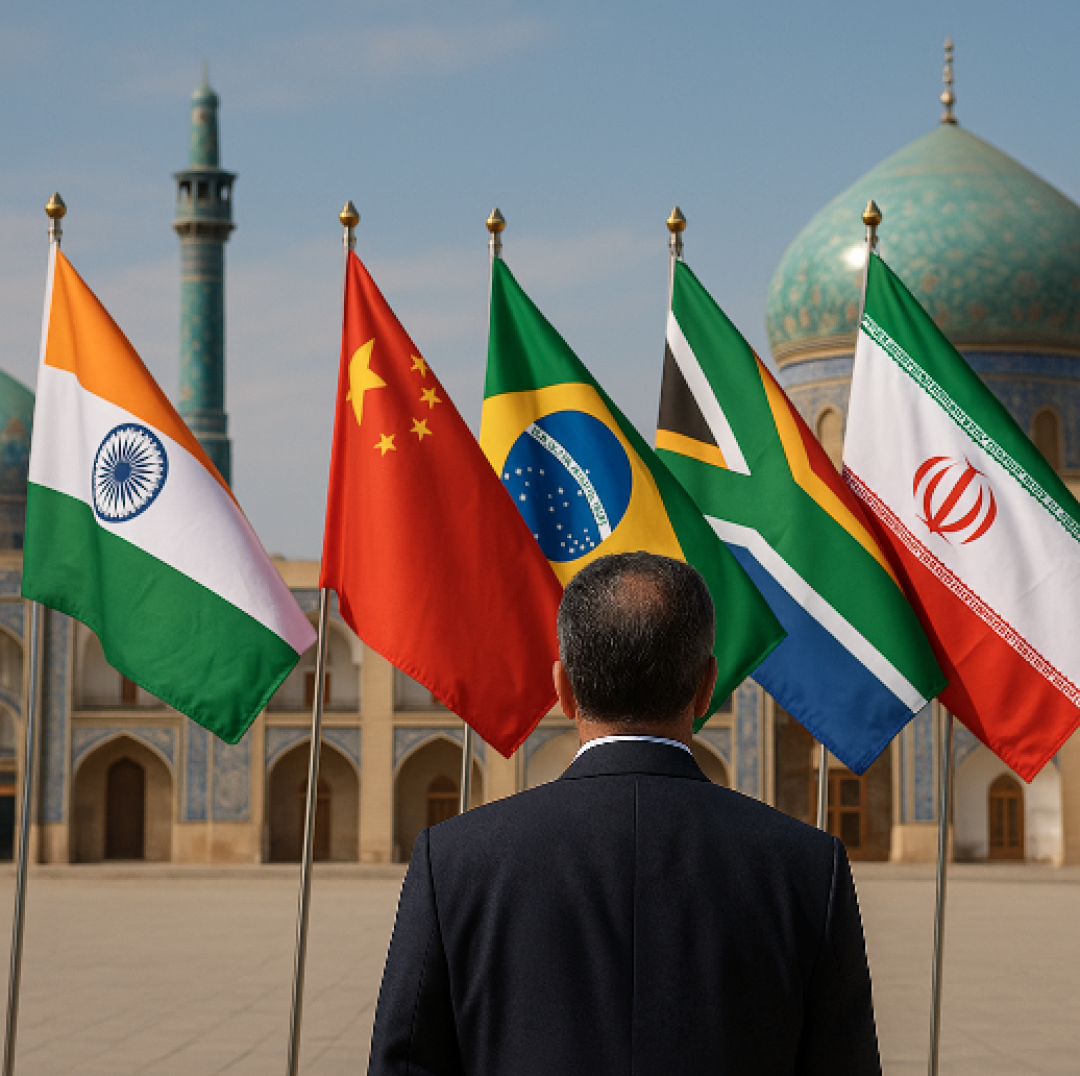
The Islamic Republic of Iran is one of the Middle East's regional powers, and from a geopolitical point of view, it is currently the most favorable country in terms of energy resources and minerals, as well as its geographical location: it shares land and sea borders with 16 countries, including Armenia and Azerbaijan.
Tehran, which joined BRICS+ in 2024, aims to reap economic benefits from the privileges of the new world order, primarily bypassing sanctions and moving toward abandoning the dollar in mutual settlements. Today, the BRICS member countries are home to approximately 40% of the planet's population, account for almost a quarter of the world's GNP, and their territories cover approximately a third of the world's land. By 2030, the BRICS countries together are projected to account for 50 percent of the global economy. At the same time, BRICS is still at the beginning of its operation. The process of developing the rules and agenda of this association is underway, and the admission of new members is being discussed. The BRICS group is moving towards a "multipolar world" and its members intend to destroy the unipolar system that governs the world. At the same time, the West remains strong with its sanctions. Iran, like China and Russia, is under US sanctions. However, according to prognosis, while Iran's BRICS membership will help to partially ease the pressure of US sanctions, it will not be able to overcome the deep economic depression the country is facing. What impact could Iran's membership in BRICS+ have on the complex political and economic processes of the South Caucasus region, specifically, on Armenia and Azerbaijan?
Iran-Armenia relations
First of all, let's note that for Armenia, cooperation with Iran has the highest priority. As for Iran, it is also interested in developing relations with Armenia. Still seven years ago, the leaders of Armenia and Iran spoke about the potential for bilateral economic cooperation and increasing trade turnover to $1 billion. Seven years have passed and the volume of this trade today amounts to approximately $700 million per year.
However, with Iran's membership in BRICS, serious changes in economic relations between the two countries are unlikely, despite the fact that in the past the West turned a blind eye to the development of Iranian-Armenian economic relations, taking into account Armenia's small market for Iran and its blockade factor, even under the most severe sanctions against Iran. It should also be noted that the issue of Armenia's integration into BRICS is not on the agenda of the Armenian authorities either. Moreover, in Armenia, the issue of BRICS membership is often viewed in a black-and-white context, focusing on the influence of Russia and China.
Iran-Azerbaijan relations
As for Azerbaijan, let us be reminded that Azerbaijan, which submitted an official application for BRICS membership in mid-August 2024, was not included among the partner states at the Kazan summit in October of the same year.
Despite this, the BRICS countries are among the main investors in the economy of Azerbaijan: By the end of 2023, three countries of the union entered the top 10 in terms of the volume of foreign direct investment in the Azerbaijani economy. Thus, based on the results, by the end of 2023, the Russian Federation invested $617.339 million in Azerbaijan (an increase of 19.2%), Iran - $395.983 million (an increase of 10%), the UAE - $318.967 million (an increase of 16%).
Nevertheless, in political terms, relations between Iran and Azerbaijan are quite complicated. One problem in relations between Baku and Tehran was and still is Azerbaijan's cooperation with Israel and the United States, which in Iran is perceived as an attempt to destroy relations between Tehran and Baku. For many years, the conflict between Armenia and Azerbaijan also complicated relations between the two countries, and in Baku, at the socio-political level, dissatisfaction was often expressed with the position of Tehran, which maintained close ties with Yerevan. Tehran has declared its borders with Armenia as its “red lines.” Iran believes that the so-called "Zangezur Corridor," which is supposed to pass through Armenia's Syunik region, could cut Iran off from Armenia and lead to further strengthening of Turkey in the region.
No shift in the balance of power is anticipated in the region –Armenian experts are sure
Armenian political experts do not prognosticate a surge of Iran's influence on regional politics in the Caucasus (in particular, Azerbaijan and Armenia) in the coming years due to its membership in BRICS+.
In an interview with Caucasus Watch, former Director of Institute of Oriental Studies of the National Academy of Sciences of Armenia and former deputy director of the Department of Political Analysis of the President of Armenia, Professor Ruben Safrastyan mentioned that he does not believe that Iran's membership in BRICS+ can have a significant impact on Caucasian regional politics and change the balance of power in the region.
"This region has its own internal logic, and in my opinion, BRICS is not the organization that can influence the processes taking place in the region, especially since Russia is already a member of BRICS+, so Iran's membership is more related to global processes, rather than regional ones. Moreover, we know that Iran is starting to implement deeper cooperation with the Eurasian Economic Union, so I consider that even more important”, the political scientist alluded.
Professor Safrastyan considers the perspectives and real potential of mutual and shared development in economic and political affairs among the BRICS+ members to be a rather complex issue amid the increasing tariffs by the US government on some of the BRICS+ members.
"My general perception is that in the contemporary world, we see the formation and increasing weight of various types of unions, including BRICS, the goal of which, as we realize, is to weaken the economic influence of the dollar and the United States in the world. On the other hand, I don't think that BRICS will have much opportunity to further strengthen its influence, because, at least at the current stage, the US is still able to significantly dictate its approaches to the world economy. We see this in the so-called tariff policy that the Trump administration is implementing, and it is having quite an impact, including on BRICS member countries. So, I don't think that, at least at the current stage, BRICS can assume a role in the world that could undermine and weaken the dominance of the US and its allies, Western countries, in the economic sphere. But I cannot foresee what developments will occur in the near future. In any case, some processes are taking place, but will these processes be strong enough to pose a serious threat to the dominance of the US and the dollar in the world? Let's not forget that the most economically powerful country in the BRICS is China, and in my opinion, relations between China and the United States will occupy an increasingly important place in global politics, and primarily in the economic sphere, in the coming years. Much will depend on this rivalry between the US and China, including the prospects of BRICS” Professor Safrastyan concludes. The political scientist also skeptically assessed the prospects to join the BRICS+ by Azerbaijan, as he sees no enthusiasm expressed by the latter.
Iran's membership in BRICS - a desperate step
In a conversation with Caucasus Watch, Associate Professor of International Relations and Diplomacy at the Yerevan State University and Head of the Organization Integration and Development and Coordinator of Eurasian Expert Club, Aram Safaryan considers Iran's membership in BRICS+ as a last resort to realize its economic potential through regional integration.
"The ever-increasing Western sanctions and the harsh and intolerant stance towards Iran's nuclear program have created a situation where the living standards in Iran significantly deteriorated over the past 20 years. Today, Iran's GDP per capita is $5,400, while Armenia's is $8,800, and Iran is gradually facing greater difficulties in its economic policy. I believe that membership in the Eurasian Economic Union processes, in particular the formation of a free trade zone with the EAEU, membership in BRICS and the Shanghai Cooperation Organization, is dictated by Iran's wish to find opportunities to leverage Eurasian regional cooperation in a broader sense to serve its economic interests. As a political analyst, I clearly see that Iran simply has no other way than to cooperate with all the countries of the Eurasian region - Russia, China, India, Pakistan, and other smaller players - in order to be able to make its economic policy successful," Safaryan is convinced.
Nevertheless, the political scientist does not anticipate that there could be a social uprising in Iran due to economic difficulties. Moreover, he believes that the Iranian authorities, despite being completely rejected by the West, have authority within the country and will be able to keep the situation under control.
Iran's growing influence in the region is not evident
In terms of Iran's rising impact on the region with its membership in BRICS+, Aram Safaryan, like our previous interlocutor, does not predict. Aram Safaryan also does not foresee a change in the balance of power in the Russia-Turkey-Iran triangle and in the interests of the US-European Union, but in absolute terms, the economic interests of all major geopolitical players in the region will increase. The political scientist is convinced that the issues in our region will be resolved in the 3+3 format, that is, Armenia-Azerbaijan-Georgia, plus Russia-Turkey-Iran, but, like the Georgians and Azerbaijanis, the Armenians will also have in mind the US-European Union perspective. According to the political scientist, these two forces are such active players in this region that even if they are sitting around the formal table or not, everyone will think about coordinating their relations with these countries.
Impact on Armenia and Azerbaijan
In a conversation with us, political scientist Aram Safaryan expressed confidence that, " Definitely, Iran would like to have greater relations with the Republic of Armenia, because Armenia is the only country in the EAEU that has a land border with it, and that agreement, which is already in force with the EAEU, is the shortest and most feasible way to enter the EAEU through Armenia. Moreover, this summer, the Prime Minister of Armenia and the President of the Islamic Republic of Iran agreed that the current trade turnover of $700 million should be increased to $1 billion in the coming years, however, they don't detail what resources will be needed to make this possible," the political scientist wonders by alluding, that, inherently, this will be possible through applying the synergy effect, increasing trade volumes on the Armenia-EAEU route with the support of Armenia, Russia, and other countries. Aram Safaryan also draws attention to the fact that Iran's policy is currently in the spotlight of the EAEU countries, not only Russia, but also Kazakhstan and Belarus, as they are also trying to figure out whether it is possible to increase the potential of trade and economic relations with this country. "This is a key circumstance that dictates that Armenia does not lag behind the processes. I predict that over the next 5 years, we will be dealing with the increasing influence of Turkey, not Iran, in the South Caucasus region. I believe that Turkey's economic potential and its exceptional relations with the US and the European Union will enable it to emerge victorious in the rivalry with Iran and increase its influence in the South Caucasus. This will also happen through the exploitation of the Meghri corridor and the normalization of relations with Armenia”, Aram Safaryan is convinced.
As for what impact could Iran's membership in BRICS+ have on Azerbaijan, against the backdrop of complex Iranian-Azerbaijani political relations, especially considering that Azerbaijan has also submitted a claim to join BRICS+, and whether Iran could preclude Azerbaijan's entry into BRICS+, Aram Safaryan gave a negative answer to this question asserting, “If Azerbaijan wants to become a member of BRICS+, its resources are sufficient to make it its own. I think that Iran cannot create obstacles for Azerbaijan to become member of BRICS+.”
Unblocking transport communications is inevitable in the region
Political scientist Aram Safaryan notes that since Armenia has been partially blockaded by Turkey and Azerbaijan since 1993, a kind of conservative and backward approach to regional processes has evolved in Armenia. "We have a blockade mentality, and that is why we have not been able to assess the full depth of regional processes, while there are significant shifts in our region. In addition to the increasing influence of Turkey, all the superpowers, the US, the European Union, China, and even Israel, are active players in our region today. Under these circumstances, when the warfare with Azerbaijan ended, Armenia was defeated in the 44-day war, and in the new situation, the issue of unblocking transport communications arose. We are only just realized that swift development processes are underway in the region and we are excited by these changes”. Regarding Armenia's relations with Azerbaijan, Aram Safaryan considers the signing of a peace treaty and the opening of Armenia's routs to all neighbors, including Turkey and Azerbaijan, inevitable in the current geopolitical situation. The rest, as per the political scientist, are technical issues that can be solved.
The political scientist also notes that although the Washington Declaration between Armenia and Azerbaijan was signed in August, and everyone was delighted with the prospect that America's presence in the region could bring stability and peace, some time passed, and they saw how many reservations, questions and doubts there were. Nonetheless, the political scientist expresses confidence that this project will be realized: "Because if there is no Meghri corridor, it will be a permanent war between Armenia and Azerbaijan," Aram Safaryan claims.
BRICS+ is not an anti-Western project
There are also presumptions among western political and expert circles that Russia considers the BRICS+ platform its own and is trying to turn it into an anti-Western one. The coordinator of Eurasian Expert Club Aram Safaryan gives the following explanation for these assumptions: "It is clear that in today's world, global rivalry is evolving between two countries: the United States and China, and these countries have formed two poles in the world around which the world must be able to organize itself. Russia is completely moving towards China due to the Ukrainian crisis and is relying on friendship with this country, in addition to trying to develop relations with India, which needs Russian gas and oil. In this situation, the impression may be created that BRICS+ is an anti-Anglo-Saxon alliance, but I don't think so. The mere presence of India and Brazil in that bloc dispels all those doubts, because India is so strongly tied to England and the Anglo-Saxon world, as no other major country is. I think that an opportunity has simply been created to develop the economy through interconnection with each other, under conditions of preferential economic regimes and low tariffs. Countries want to take advantage of this opportunity and increase the potential of their economic power - this is the meaning of BRICS+. Of course, if we look at it from a hostile perspective, BRICS+ is a defensive form of getting rid of American and European influence and pressure, but on the other hand, we shouldn't look at it that way, because sooner or later, the countries of the Eurasian region should have been able to organize themselves. This is the order of the times, and no matter how much Trump wants to lift tariffs, these countries will not refrain from enhancing close horizontal ties with each other”, Aram Safaryan concludes.
Contributed by Anna Vardanyan, a political journalist-researcher from Armenia based in Yerevan. Her 18-year professional and academic research career is closely related to international relations, political science, and security policy topics within the Eastern Europe and Caucasus region overall.
Insights,
Politics,
Armenia, Azerbaijan, Georgia |
China, South Caucasus, Russia, Iran, BRICS, Anna Vardanyan