
Aliyev Highlights Zangezur Corridor, Supports Ukraine, Discusses Baku's Mediation in Türkiye-Israel Dialogue, and Rejects Aggressive Statements from Iran and Russia
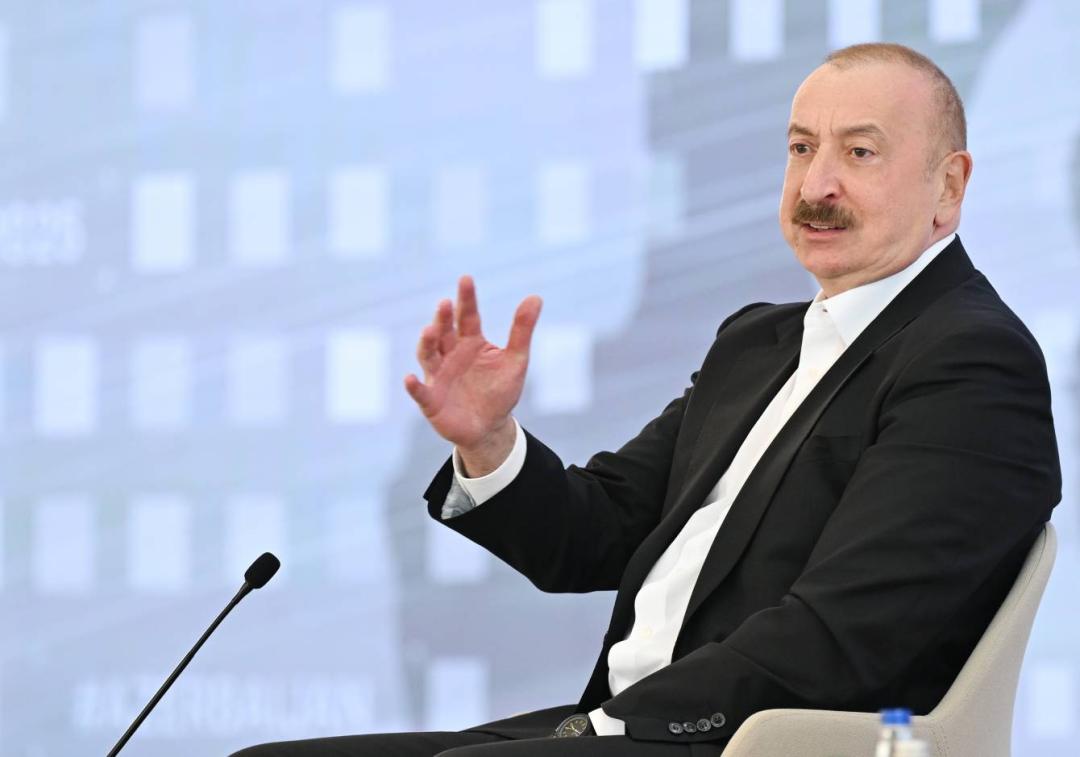
On August 27, Ilham Aliyev, the President of Azerbaijan, gave an interview to Al Arabiya in which he discussed the Zangezur Corridor, peace with Armenia, regional connectivity, international relations, energy projects, and historical grievances, emphasizing security guarantees, infrastructure development, and Azerbaijan’s growing role in regional stability.
Aliyev stated that constructing the physical infrastructure of the Zangezur Corridor would not take long, emphasizing that "it’s only 42 kilometers". He noted that Azerbaijan could build the railway within a year, while Armenia might need more time due to less experience in railroad construction. Although it was not yet decided whether American investors would take part in the project, he added that it was possible. What mattered most for Baku, he stressed, was the construction of the corridor with international security guarantees, ensuring that Azerbaijanis traveling between Nakhchivan and the mainland would not feel insecure.
The President underlined that the negotiations lasted several years and concluded in Washington with the support of President Donald Trump and his administration. According to him, this marked "the end of the conflict, the end of the war," even though a formal peace agreement was pending due to a clause in the Armenian constitution questioning Azerbaijan's territorial integrity. Aliyev emphasized that once Armenia amends its constitution and removes such claims, the formal agreement would be signed. He described the document initialed at the White House in front of Trump as confirmation of "the end of the war" and a new opportunity for the South Caucasus, Central Asia, and the Middle East.
Aliyev also recalled that the dissolution of the Minsk Group was one of Azerbaijan’s early conditions in negotiations. He argued that since Armenia had recognized Karabakh as part of Azerbaijan, the Minsk Group's continued existence was meaningless. He said Baku and Yerevan jointly sent a letter to the OSCE to dissolve the body, describing this as the "legal death" of the group, which had been ineffective for nearly five years.
Speaking about the First Karabakh War, Aliyev stressed that there were no Armenian IDPs because Azerbaijan did not occupy Armenian territory. Instead, he recalled that Armenians had occupied Azerbaijani lands, creating hundreds of thousands of Azerbaijani refugees and IDPs, many of whom lived in tent camps for more than a decade. He stated that these camps were abolished by 2007, but poor conditions persisted for many until the "Great Return" program began following the Second Karabakh War. Aliyev said that more than 50,000 people had already been resettled in the liberated territories, although the process faced two main obstacles: landmines and the widespread destruction of infrastructure. According to him, more than a million landmines were planted, causing nearly 400 casualties since 2020, while infrastructure had been completely ruined. He stressed that Azerbaijan was nearing the final stage of infrastructure development and was now investing heavily in housing projects.
Aliyev also expressed strong support for Trump, saying he "really deserves the Nobel Peace Prize". He praised Trump’s achievements in Africa, Asia, and the South Caucasus, describing him as "very friendly" and "generous". He criticized the alleged electoral fraud in the US, claiming Trump was deprived of victory by the "deep state".
Turning to international relations, Aliyev stated that Azerbaijan had supported Ukraine's territorial integrity from the first days of the Russian invasion and continued to do so. He also emphasized Azerbaijan’s opposition to separatism, whether in Karabakh, Syria, or elsewhere. On energy cooperation, he said Azerbaijan could provide gas supplies to Syria and other countries through the Arabian Gas Pipeline or swaps, while also acting as an international energy trader. He highlighted strong partnerships with Gulf countries, particularly the UAE and Saudi Arabia, which were the main investors in Azerbaijan’s renewable energy projects.
Answering a question on the Russian military presence, Aliyev underlined that "there is not a single Russian soldier on Azerbaijani soil". He noted that Russia maintained a base in Armenia and guarded Armenia's borders with Iran and Türkiye, but he did not wish to speculate on negative scenarios. Reflecting on history, Aliyev recalled that Azerbaijan established the first democratic republic in the Muslim world in 1918, which was occupied by the Russian army in 1920. He noted that later that year, Soviet Russia transferred Western Zangezur from Azerbaijan to Armenia, dividing the Azerbaijani mainland from Nakhchivan. He stressed that this division only became problematic after Armenia's aggression against Azerbaijan, when the corridor was cut. Aliyev warned that if Armenia reversed its commitments made in Washington, it would "seriously deteriorate relations between Armenia and the United States," as well as with the broader international community, including Europe, Türkiye, and Arab states. He emphasized that what was signed in Washington was a guarantee of peace and development for Armenia itself, and breaking it would mean "going against the entire world".
The President stated that the downing of an Azerbaijani civilian plane by Russia and the subsequent reaction of Russian officials caused deep frustration and disappointment in Baku. Aliyev emphasized that the incident should never have taken place. He explained that when Russian airports are attacked by drones, a special regime called "carpet" is usually announced, and planes receive signals to turn back. "Two weeks before this crash, the same happened with our plane, which was flying to the same Russian city, and it got the signal, so it turned back. This time, they did not give this signal. They gave the signal after the plane was already shot down," he stated. According to him, the Russian side acted deliberately to mislead any investigation. He added that the aircraft was struck twice and only the professionalism of the pilots saved lives. The president underlined that the plane managed to land in Kazakhstan, not in Russia. "It landed in Kazakhstan, and there was a crash. Some people survived, and we have witnesses who gave evidence. We have two people who were in the plane who were injured by the shrapnel, which penetrated the fuselage. The entire fuselage was full of shrapnel holes. It was damaged by a Russian air defense system. So shooting down the plane should not have happened in the first place, but it was a tragic mistake," Aliyev said.
Speaking about Azerbaijan’s relations with the US, Aliyev recalled that ties with the administration of former President Joe Biden had dropped to zero. He stated that Biden had reimposed Section 907, which had been lifted in 2001 when Washington needed Azerbaijan's airspace, seaports, and railways to support operations in Afghanistan. "As soon as Biden ran away from Afghanistan, they reimposed sanctions on us. So can you be so ungrateful? What would we think about you? We cut off all relations with them. With the Biden administration, it was zero. It was a disaster," Aliyev emphasized. In contrast, he described Donald Trump as "a brave man and a great leader," noting that he believed Trump could restore both the greatness and global admiration of the US. He particularly praised Trump's reaction during the recent assassination attempt, calling it a sign of his personal courage.
Turning to regional connectivity, Aliyev explained that the Zangezur Corridor would reinforce the existing North-South transport route through Iran. He stated that the original corridor runs from Northern Europe through Russia, Azerbaijan, and Iran, and then to the Persian Gulf. Azerbaijan had already completed the railroad and highway connections between its border with Russia and its border with Iran, while the missing section was on Iranian territory. According to Aliyev, Zangezur could become an alternative link, connecting Northern Europe to Russia, then Azerbaijan, onward to Nakhchivan, and from there to Iran and the Persian Gulf. "The Zangezur Corridor will not only be East-West, but also a North-South transportation corridor," he emphasized, adding that such development would benefit the entire region without creating losers.
Aliyev also spoke about Azerbaijan’s cooperation with Iran, noting his close ties with Iranian President Masoud Pezeshkian. He pointed out that they did not need interpreters since both spoke the same language. "He’s Azerbaijani. He has the same blood as I do. We speak the same language. We don’t need interpreters. Actually, he demonstrated his knowledge of Azerbaijani poetry during one of the public events here, and he doesn’t need any notes. He’s a very talented person," Aliyev stated.
On foreign policy priorities, Aliyev highlighted cooperation with the Persian Gulf countries. He explained that although Europe remained Azerbaijan's main natural gas market—with supplies already reaching ten European states, eight of which are EU members—Baku was also looking at opportunities in the Middle East. He said that an additional eight billion cubic meters of natural gas would be available by 2030. Azerbaijan planned to export part of this through Syria and other Middle Eastern markets using the Arabian Gas Pipeline or swap arrangements. The president also underscored that Azerbaijan was not only exporting its own oil and gas but was also acting as an international energy trader. He added that Gulf states were already among the largest investors in Azerbaijan’s renewable energy sector. "By 2030, based on signed contracts and investments primarily from the UAE, Saudi Arabia, and China, we plan to have six gigawatts of solar and wind energy," Aliyev said. He mentioned hydroelectric projects in Karabakh and pointed out that the UAE's ADNOC had acquired shares in major Azerbaijani gas fields, while SOCAR had become a shareholder in oil projects in the UAE. According to him, cooperation extended beyond energy to hospitality, tourism, agriculture, and desalination projects.
Aliyev further discussed the Organization of Turkic States (OTS), stressing its growing global importance. He noted that Azerbaijan had always advocated for strengthening the body, which had developed from a consultative platform into a more structured organization. He recalled the Shusha Declaration of 2021, which turned Azerbaijan and Türkiye into formal allies, as well as strategic agreements signed with Uzbekistan and other OTS members. "We are united by our roots, which makes this organization unique," Aliyev said, pointing out that the Turkic nations shared common ethnicity, population growth, political stability, and economic resources. He emphasized that Türkiye had become a leading global military power, while Azerbaijan had proven its strength on the battlefield. "When we talk about corridors, you cannot avoid us. You cannot; you should use us, our territories, our facilities," Aliyev stressed. He added that the OTS had the potential to become a stabilizing global actor through concrete projects in energy, transportation, and culture, bringing opportunities rather than threats to the wider region.
Aliyev stated that the administration of President Donald Trump accepted Azerbaijan’s legitimate concerns about the route passing through Armenia, which led to the initiative being named TRIPP — Trump Route for International Peace and Prosperity. The President explained that currently, access to Nakhchivan requires either air travel, road transit through Iran, or even longer routes via Georgia and Türkiye, which creates serious inconvenience. He emphasized that after Azerbaijan's victory in the Second Karabakh War, Baku had the military capacity to take control of the route by force but chose restraint. "At that time, the Armenian army was totally demoralized. There were 12,000 deserters who ran from the war in the Armenian army and zero in the Azerbaijani army," Aliyev noted. He added that Azerbaijan stopped at its borders on November 10, 2020, and instead initiated negotiations with Armenia on connectivity lines. Despite five years of talks, he underlined that Yerevan had not shown a constructive approach. According to him, Azerbaijan proceeded with building a railroad and highways toward the Armenian border to ensure an eventual connection to Nakhchivan. The Azerbaijani leader stressed that when President Donald Trump's team became involved, Baku insisted that without the Zangezur Corridor being opened and secured with international guarantees, Azerbaijani citizens could not travel safely across the 40-kilometer route.
Turning to regional mediation, Aliyev underlined that Azerbaijan has played a role in facilitating dialogue between Türkiye and Israel. "We are trying to be helpful when we see that there's a chance for normalization. And during the first stage of normalization between Türkiye and Israel, Azerbaijan's role was appreciated by both countries," he said. He added that, given the current escalation in tensions, if requested, Azerbaijan would once again step in, or otherwise continue less public efforts to encourage dialogue, prioritizing security and stability.
Aliyev also emphasized the constructive and friendly relations with Iranian President Masoud Pezeshkian and his administration. He described Iran's official position on recent developments as "very reasonable and very positive," highlighting that Azerbaijan bases its policy on the elected leadership of Iran — the president and the foreign minister. The Azerbaijani president dismissed the statements of former Iranian officials now acting as advisers as irrelevant, stressing that Baku only values the official positions of the government. He underlined that Tehran understands the Zangezur Corridor is not a threat to Iran. Addressing rumors about Azerbaijan's alleged plans to occupy Zangazur or cut the Iranian-Armenian border, Aliyev rejected them as "absolutely false". He pointed out that if Azerbaijan had intended to take such action, it could have done so in November 2020. "We are not aggressors. We are not a country that occupies. We are a people and a country that liberates," he stressed, noting that Azerbaijan's war was one of liberation and justice.
Aliyev further explained that, in response to Armenia’s blocking of the Zangezur Corridor, Azerbaijan and Iran agreed to build an alternative route called the Araz Corridor, named after the Araz River. Baku has already invested in the construction of a bridge across the river to enable transport through Iranian territory to Nakhchivan. He added that when the route through Armenia is eventually opened, Azerbaijan will have two options for cargo delivery — one through Armenia and one through Iran — and that discussions with Tehran also included the possibility of constructing a parallel railroad on the Iranian side.
Speaking on relations with Russia, Aliyev underlined that Azerbaijan was not responsible for the deterioration of ties. He pointed to attacks against Azerbaijanis in Russia, where individuals were killed under unclear circumstances. "Two people were killed and tortured, and then the official information was that they died of a heart attack. Even if they committed a crime 20 years ago, as they say, they are people. They must not be treated like that," he stated. The president stressed that Azerbaijan responds constructively and within the law but "will never tolerate any sign or demonstration of aggression or disrespect" towards its citizens or its nation.
He stated that Baku may increase natural gas supplies to Syria. Aliyev explained that a trilateral, and even quadrilateral, arrangement had been established between Azerbaijan, Syria, Türkiye, and Qatar to assist Syria with natural gas for electricity production. He noted that the ceremony marking the start of this process took place on August 2. According to him, Azerbaijani gas was being delivered to Syria through Türkiye, while the Qatari government generously provided the necessary funding. "So far, we have agreed on about 1.2 billion cubic meters of natural gas to Syria, but their demands are higher. So in the future, we can increase the volume of gas so that they experience fewer shortages," Aliyev emphasized.
News,
Politics,
Azerbaijan |
Russia, Turkey, Iran, Israel, Ukraine, Ilham Aliyev, Armenia-Azerbaijan Relations, Zangezur Corridor