
Azerbaijan Lifts Transit Ban to Armenia; First Kazakh Shipment En Route
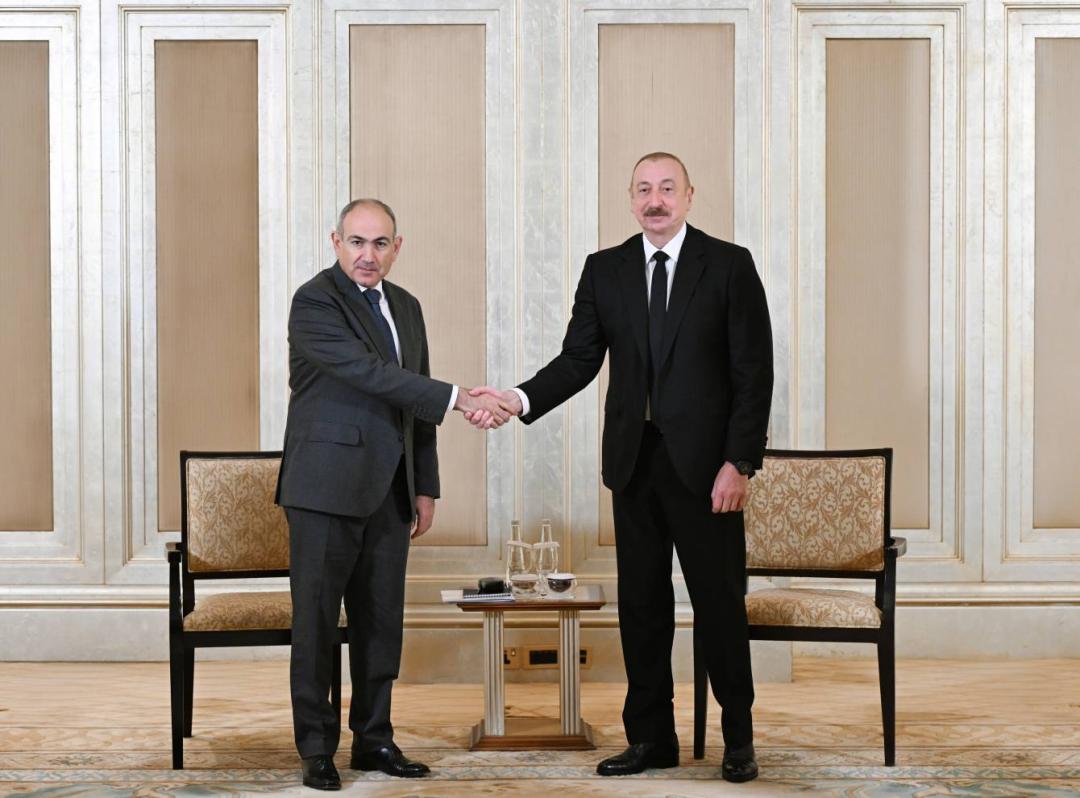
Azerbaijani President Ilham Aliyev announced on October 21 that Azerbaijan has lifted all restrictions on the transit of goods to Armenia, marking another step in the post-conflict normalization process between the two countries.
“I should also note that the first such transit shipment was a consignment of Kazakh grain to Armenia. I believe this is a clear indication that peace between Azerbaijan and Armenia exists not only on paper but also in practice,” Aliyev said at a joint press conference with Kazakh President Kassym-Jomart Tokayev, according to the Azerbaijani news agency APA.
Armenia welcomed the announcement, calling it an important step toward fostering peace and regional cooperation.
“The Republic of Armenia welcomes the statement made by the President of the Republic of Azerbaijan regarding the lifting of restrictions on the transit of goods to Armenia. This step holds significant importance for the opening of regional connectivity, strengthening mutual trust, and institutionalizing peace between Armenia and Azerbaijan, in line with the agreements reached in Washington,” said Nazeli Baghdasaryan, spokesperson for Prime Minister Nikol Pashinyan.
The development follows the U.S.-brokered peace agreements signed in Washington on August 8, which paved the way for improved transport and trade links under the framework of the Trump Route for International Peace and Prosperity (TRIPP) initiative.
Economy Minister Gevorg Papoyan said the first transit shipment through Azerbaijani territory is expected to reach Armenia soon. “Soon, the first batch of Kazakh wheat will enter Armenia via the Aktau–Baku route, followed by transit through Azerbaijani and Georgian railways. Peace has been established,” Papoyan said.
Meanwhile, efforts continue to reopen transport connections between Armenia and Türkiye. Vice Speaker of Parliament Ruben Rubinyan, Armenia’s Special Representative for Normalization with Türkiye, announced that a new meeting with Turkish authorities will soon take place to discuss the restoration of the Gyumri–Kars railway.
“An interdepartmental meeting on the restoration and relaunch of the Gyumri–Kars railway will take place in the near future. Further details will be provided afterward,” Rubinyan said.
In September, Rubinyan met with his Turkish counterpart Serdar Kılıç in Yerevan, where both sides agreed that relevant authorities would conduct technical studies for reopening the Gyumri–Kars railway and the electricity interconnector—signaling tangible progress in the long-stalled normalization process.
On October 22, during his participation at the Silk Road conference in Georgia, Nikol Pashinyan, the Prime Minister of Armenia, emphasized that while Yerevan was politically ready to ensure cargo transit between the Nakhchivan Autonomous Republic and mainland Azerbaijan through Armenian territory, the country was not yet technically prepared due to insufficient infrastructure. "Politically, we are also ready to ensure rail transit between Turkey and the Nakhchivan Autonomous Republic, as well as between Turkey and mainland Azerbaijan, but the railway in these sections requires repair or reconstruction. I am confident that the technical issues will be resolved within two to three years," Pashinyan stated. He added that new pipelines, as well as Azerbaijan–Armenia–Turkey power lines, would soon be developed through Armenian territory, and both rail and road connections would be established. "All of this is being discussed within the framework of the TRIPP program. We are also conducting relevant negotiations with Turkey and Azerbaijan. We are also working with the United States to implement these agreements," Pashinyan emphasized.
According to the Armenian Prime Minister, both parties were currently finalizing the signing and ratification of the Agreement on Peace and the Establishment of Interstate Relations between Armenia and Azerbaijan, which had been initialed in Washington. He noted that, in parallel, all transport links would gradually be reopened, bringing "historic changes to our region". Addressing regional transport initiatives, Pashinyan rejected claims that infrastructure projects in the South Caucasus were competing with one another. "I categorically disagree with this assertion, as the transport routes in our region complement each other, increasing the transit potential of the South Caucasus," he stated. He also referred to the third point of the Washington Declaration, which included plans to open the Persian Gulf–Black Sea railway, significantly enhancing the transit capacity of Armenia, Georgia, and Azerbaijan alike.
News,
Politics,
Armenia, Azerbaijan |
Nikol Pashinyan, Ilham Aliyev, Kazakhstan, Armenia-Azerbaijan Relations, Gevorg Papoyan