
The Resilience And Growth Plan Driving Armenia's Key Infrastructure Projects
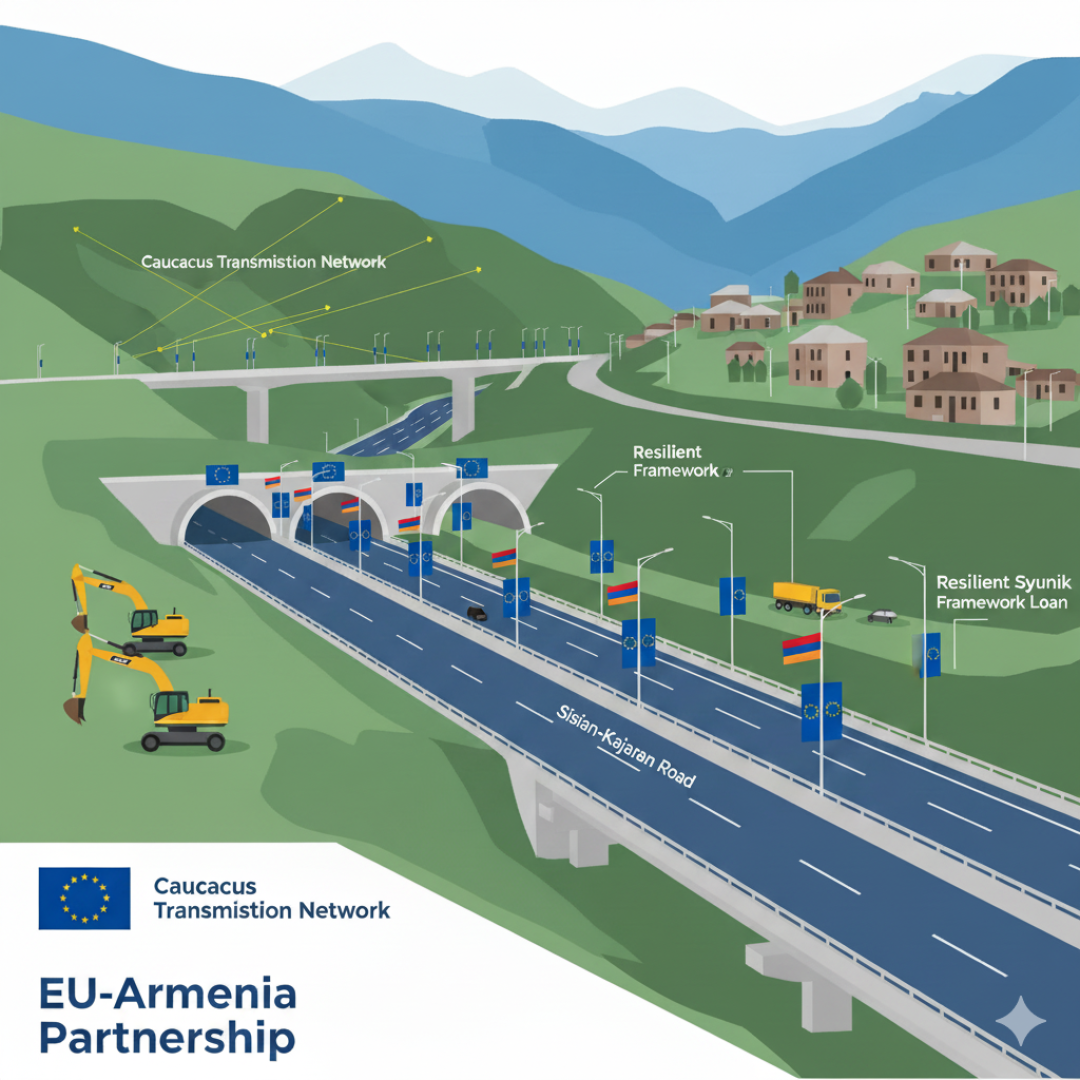
Armenia’s future resilience and growth hinge significantly on developing key infrastructure projects that align with sustainable development goals (SDGs) and address the unique challenges faced by the nation. The Resilience and Growth Plan (2024-2027) is a strategic initiative by the European Union (EU) in Armenia to strengthen the country’s economic resilience, infrastructure development, and regional connectivity. Establishing robust transport links facilitates trade and enhances Armenia’s position within the broader geopolitical landscape, allowing for greater economic collaboration with neighboring countries. This article examines the impact of three major EU-backed projects: the Caucasus Transmission Network, the Sisian-Kajaran Road, and the Resilient Syunik Framework Loan. These initiatives are key in enhancing Armenia’s energy security, modernizing trade routes, and fostering rural development. This analysis evaluates their long-term economic and geopolitical significance and potential to attract further EU investments. The role of the EU-Armenia Investment Coordination Platform is also explored, highlighting its contribution to economic stability and Armenia’s gradual integration with European economic standards.
Background
Armenia’s location between Europe, the Middle East, and Central Asia makes it an important economic link. However, the country’s infrastructure has historically lagged, limiting trade efficiency, regional connectivity, and energy security. Armenia has traditionally relied on Russia for energy imports and Iran for alternative trade routes. Still, recent geopolitical tensions, as noted by the International Energy Agency in 2023, have highlighted the risks of these dependencies.
In response, Armenia has strengthened its collaboration with the European Union, seeking investment opportunities to modernize its economy. The EU-Armenia Investment Coordination Platform, established in 2021, facilitates high-level discussions between Armenia, the EU, and international financial institutions to support sustainable investments in strategic sectors, according to the European External Action Service. In April 2024, the Resilience and Growth Plan was announced, allocating €270 million—including €200 million in grants and €70 million in leveraged investment funds—to finance projects aimed at economic development, connectivity, and resilience, the European Investment Bank reported.
The Caucasus Transmission Network (CTN), the Sisian-Kajaran Road, and the Resilient Syunik Framework Loan are among the most ambitious projects financed under this framework. These initiatives focus on diversifying Armenia’s energy sector, improving logistics infrastructure, and revitalizing rural areas. Together, they position Armenia for long-term economic growth and deeper integration into global markets.
The Armenian government acknowledges that transport infrastructure is crucial in driving economic growth. Efficient, reliable, and cost-effective transportation systems are essential for regional development and prosperity. A decade of study and panel data analysis have demonstrated a positive correlation between infrastructure investment and economic performance in Armenia, Georgia, and Turkey, highlighting the significant impact of improved connectivity on economic activity. This underscores that enhancing transport infrastructure is not solely about logistical efficiency but is integral to strengthening the broader economic framework of the region.
Energy Security and Regional Integration: The Caucasus Transmission Network
The Caucasus Transmission Network aims to integrate Armenia and Georgia’s electricity grids, enhancing energy security and interconnectivity. Initially launched in 2015, the project was delayed due to funding constraints and adjustments in cost planning. However, renewed efforts in 2024, backed by €188 million from the European Investment Bank, the European Bank for Reconstruction and Development, and KfW Bank, have restarted the project.
The network will initially increase the energy exchange capacity between Armenia and Georgia from 200 to 350 megawatts, with a long-term goal of 1,050 megawatts. The project includes the construction of a high-voltage direct current station in Ayrum. According to the International Energy Agency, this will allow Armenia to export excess electricity to Georgia and, potentially, the EU through a planned Black Sea transmission cable between Georgia and Romania.
This project is essential for Armenia’s energy diversification, reducing its reliance on Russian gas imports and increasing energy trade flexibility. Moreover, it strengthens Armenia’s position as a regional energy hub capable of trading electricity with Georgia and Iran while ensuring a more stable and sustainable energy supply for future growth.
Trade and Economic Growth: The Sisian-Kajaran Road
The Sisian-Kajaran Road is a key component of the North-South Transport Corridor, which aims to improve Armenia’s connectivity with Georgia, Iran, and Europe. This 60 km roadway, funded by €472 million in loans from the European Investment Bank and the European Bank for Reconstruction and Development, is expected to shorten travel distances by 12-15 percent and reduce transit times between Yerevan and Syunik by nearly 40 percent.
Armenia, which is excluded from regional rail projects like the Baku-Tbilisi-Kars railway, relies on road infrastructure to diversify its trade. The project will enable Armenia to bypass transportation bottlenecks, facilitating more efficient logistics between the Persian Gulf and European markets. Additionally, improved roads will boost economic activity in rural regions, making them more accessible for tourism, agriculture, and small businesses.
Rural Development and Economic Resilience: The Resilient Syunik Framework
According to the European External Action Service, Syunik has become more strategic following border tensions with Azerbaijan, prompting new investments in economic resilience. This project focuses on three areas:
- Infrastructure Development: Investments in roads, water supply, and municipal services to improve residents’ quality of life.
- Business growth: For micro, small, and medium-sized enterprises to drive economic sustainability financial support.
- Green development: Investments in renewable energy, biodiversity conservation, and climate-resilient construction to promote sustainability.
This initiative is critical in stabilizing Armenia’s economy and ensuring long-term regional security by expanding employment opportunities, reducing migration from rural areas, and fostering economic self-sufficiency.
Moving Forward
As Armenia navigates its path toward resilience and growth, it is essential to adopt a holistic approach encompassing various sectors, including energy, transport, and tourism. The interplay between these sectors will shape the country’s economic landscape and determine its ability to respond to future challenges. By leveraging international collaboration, innovative practices, and sustainable development principles, Armenia can build a resilient infrastructure framework that supports its long-term growth objectives.
The Resilience and Growth Plan, together with the Caucasus Transmission Network, the Sisian-Kajaran Road, and the Resilient Syunik Framework, marks a significant shift in Armenia’s development strategy. These projects are key to ensuring energy security, enhancing regional connectivity, and modernizing economic infrastructure.
From a geopolitical perspective, the increased EU financial commitment signals a reduced reliance on Russia and strengthens Armenia’s economic alignment with European standards. The North-South Corridor strengthens Armenia’s trade links, enabling deeper integration into global supply chains. Similarly, rural investments in Syunik will stabilize Armenia’s border regions and promote long-term economic resilience.
Armenia’s ability to leverage EU investments will shape its role as a regional economic hub in the coming years. The potential for future collaborations in transport, digital infrastructure, and industrial expansion suggests that these projects lay the foundation for Armenia’s broader economic transformation.
In conclusion, the resilience and growth plan for Armenia’s future hinges on the strategic development of key infrastructure projects across multiple sectors. Integrating sustainable practices, innovative technologies, and collaborative frameworks will be crucial in addressing the challenges posed by the COVID-19 pandemic and other socio-economic factors. By prioritizing infrastructure development, Armenia can enhance its economic stability, foster regional integration, and ultimately secure a prosperous future for its citizens.
References
- European External Action Service (EEAS). (2024). A Resilience and Growth Plan for Armenia. Retrieved from https://www.eeas.europa.eu
- European Investment Bank (EIB). (2024). EIB Global Signs €236 Million Loan for Sisian-Kajaran Road.Retrieved from https://www.eib.org
- International Energy Agency (IEA). (2023). Armenia Energy Review: Regional Integration and Sustainability Challenges. Retrieved from https://www.iea.org
- KfW Development Bank. (2024). Funding the Caucasus Transmission Network: Investment for Energy Security in Armenia and Georgia. Retrieved from https://www.kfw.de
- Government of Armenia. (2025). Third Meeting of the EU-Armenia Investment Coordination Platform Highlights Infrastructure Priorities. Retrieved from https://www.gov.am
Authors: Diana Galoyan, Ph.D., ORCID: 0000-0001-5700-764X.
Verej Isanians, Ph.D., ORCID: 0009-0008-1145-9251.
Nexus Intellect Research NGO.
News,
Politics,
Armenia |
EU, Turkey, Armenia-EU Relations, Syunik, Nexus Intellect Research NGO, Caucasus Transmission Network, Sisian-Kajaran Road