
Extension from Party Ban to Individuals Adopted by the Georgian Parliament
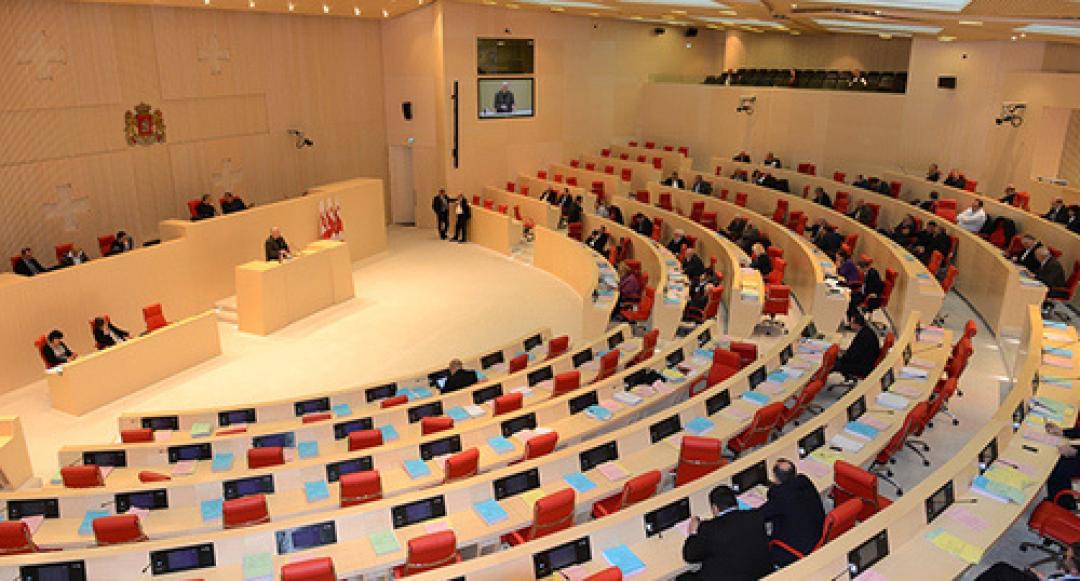
On October 16, Georgia’s ruling Georgian Dream party passed, in its final reading, a controversial legislative package that imposes sweeping political restrictions on individuals deemed “associated” with parties declared unconstitutional. The measures effectively bar such individuals from founding or joining political parties, contesting elections, or holding public or state-political office. Critics warn that the new laws could be weaponized against virtually any opposition force, cementing the ruling party’s dominance and deepening Georgia’s democratic backsliding.
The changes come amid Georgian Dream’s escalating campaign to outlaw the United National Movement (UNM)—the main opposition force and former ruling party—alongside a broad range of other political actors it brands as part of the so-called “collective UNM”. The amendments modify Article 23 of the Law on the Constitutional Court of Georgia, which allows the Court to invalidate the registration of parties deemed unconstitutional. Under the new provisions, not only can parties themselves be banned, but individuals “connected” to them will also face far-reaching restrictions.
These individuals will lose the right to establish or join political organizations, occupy leadership roles within parties or public institutions, or hold political office at any level. The legislation further permits the removal of such individuals from parliamentary or municipal representative bodies and authorizes their deletion from electoral lists upon the request of the plaintiff in the relevant constitutional case. Complementary changes to the Criminal Code introduce financial penalties for political entities that fail to comply with Constitutional Court rulings barring these individuals from political participation. Related amendments to the Electoral Code and the Law on Citizens’ Political Associations empower authorities to refuse party registration, invalidate party lists, and disqualify candidates linked to banned organizations. The new provisions also prohibit such individuals from making financial contributions to political parties.
The latest reforms build on a prior legislative package adopted in May, which granted the Constitutional Court the authority to dissolve political organizations whose leaders, objectives, or actions resemble those of already-prohibited groups. That earlier law defined as unconstitutional any organization seeking to violently alter Georgia’s constitutional order, undermine sovereignty, promote war or violence, or incite ethnic, religious, or social discord.
Georgian Dream leaders have made no secret of their intention to use these expanded powers. Prime Minister Irakli Kobakhidze announced that a Constitutional Court appeal would be filed “in the coming days,” targeting UNM and “up to ten” other parties. He stated that any group or figure “involved in sabotage against the state together with this bloody force” would face the same restrictions, promising that the full list of targeted parties would soon be revealed. According to parliamentary majority figures, the bans could also extend to individuals who are not formal party members but are perceived as supporting or advancing the political agenda of prohibited groups. As one ruling party MP explained during parliamentary debates, such individuals “may not have party membership cards, but their actions and influence serve the same goals, and that is enough to classify them as affiliated”.
Human rights organizations and opposition parties warn that the legislation poses a grave threat to Georgia’s fragile democratic system. The Georgian Young Lawyers’ Association (GYLA) cautioned that the measures blur the line between defending constitutional order and silencing political dissent. The watchdog emphasized that the restrictions are indefinite, disproportionate, and incompatible with both the Georgian Constitution and international human rights principles, warning that their implementation could “erase the foundations of political pluralism”.
The opposition landscape—already fragmented and under pressure—has reacted with alarm. Even parties hostile to UNM, including Irma Inashvili’s nationalist Alliance of Patriots, condemned the move as a tool of political persecution. Inashvili warned that the legislation’s ultimate effect would be to suppress all dissent: “Don’t you see that under the pretext of fighting the already defunct UNM, they will eventually come for every one of us?” she wrote in a social media post.
Taken together, the new laws mark one of the most significant expansions of executive control over Georgia’s political system since independence. They not only open the door for mass disqualification of opposition figures but also signal a decisive shift toward rule by exclusion—where loyalty to the ruling party becomes the primary condition for political participation.