
Georgian President Addresses the UN
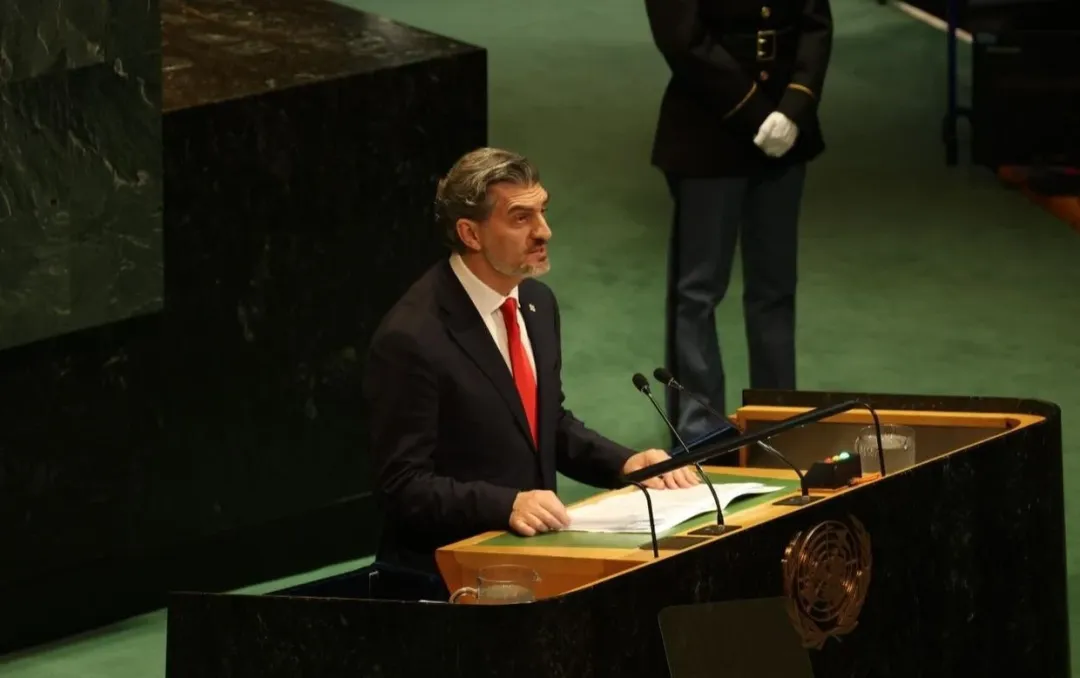
At the 80th session of the UN General Assembly on September 25, Georgian President Mikheil Kavelashvili delivered an 11-minute address that underscored his government’s vision of a “multipolar international order”. Speaking in Georgian with real-time English interpretation, he emphasized Georgia’s pragmatic foreign policy, its strategic role in the Middle Corridor, and issued a pointed warning that his country “will not be spoken to in the language of ultimatums, blackmail, or intimidation”. Kavelashvili’s speech marked a departure from past practice, where Georgian prime ministers traditionally represented the country in New York.
In his remarks, the president praised U.S. President Donald Trump’s peace efforts in the region while also reflecting on ongoing global conflicts—including the war in Ukraine, Georgia’s own 2008 war, and the unresolved issue of occupation—all while carefully avoiding any direct reference to Russia. The address opened with an invocation of Georgia’s ancient cultural heritage, described as a nation with three millennia of history, before shifting to global issues and the country’s regional role. He spoke of extending reconciliation to “Abkhaz and Ossetian brothers and sisters,” framing peace and unity as central to Georgia’s national mission. Representing “a people who understand both the price of war and the value of peace,” Kavelashvili reaffirmed that the government’s priority remains to preserve stability and shield its citizens from conflict at all costs. He condemned the “bloody and tragic war” in Ukraine, likening its devastation to Georgia’s own painful memories of 2008, and declared “firm and unwavering” solidarity with the Ukrainian people—again, without naming Moscow directly.
A significant portion of the speech focused on Georgia’s regional role and its place within the Middle Corridor, the East–West transit route linking Europe and Asia. Kavelashvili positioned Georgia as a hub for dialogue and prosperity in the South Caucasus, echoing Trump’s initiatives to foster peace between Armenia and Azerbaijan and to bring an end to the war in Ukraine. Highlighting Georgia’s ties with the South Caucasus, Central Asia, and the European Union, he argued that the country’s geography and pragmatic diplomacy make it an indispensable player on the Eurasian map. He pointed to major infrastructure investments—including the Anaklia deep-sea port project—as evidence of Georgia’s commitment to becoming a multidimensional hub for trade and energy transit. Georgia’s goal, he stressed, is to develop constructive partnerships based on mutual respect and benefit with global powers such as the United States, China, and the EU.
The president also drew a firm line on Georgia’s external relations. He warned that Georgians would never accept engagement framed in terms of pressure or threats, echoing recent Georgian Dream criticism of Western partners accused of interfering in domestic politics and pushing Georgia toward confrontation with Russia. Portraying Georgia as a responsible member of the international community, Kavelashvili insisted that the government’s rational policies have preserved peace, supported economic growth, and improved living standards. Even with 20 percent of its territory under occupation, Georgia, he argued, continues to advance with energy and determination. Turning to the unresolved conflicts, Kavelashvili appealed directly to Abkhaz and Ossetians, urging reconciliation and a shared future.
In closing, Kavelashvili thanked the international community for supporting Georgia’s sovereignty and reiterated his call for a balanced international system.