
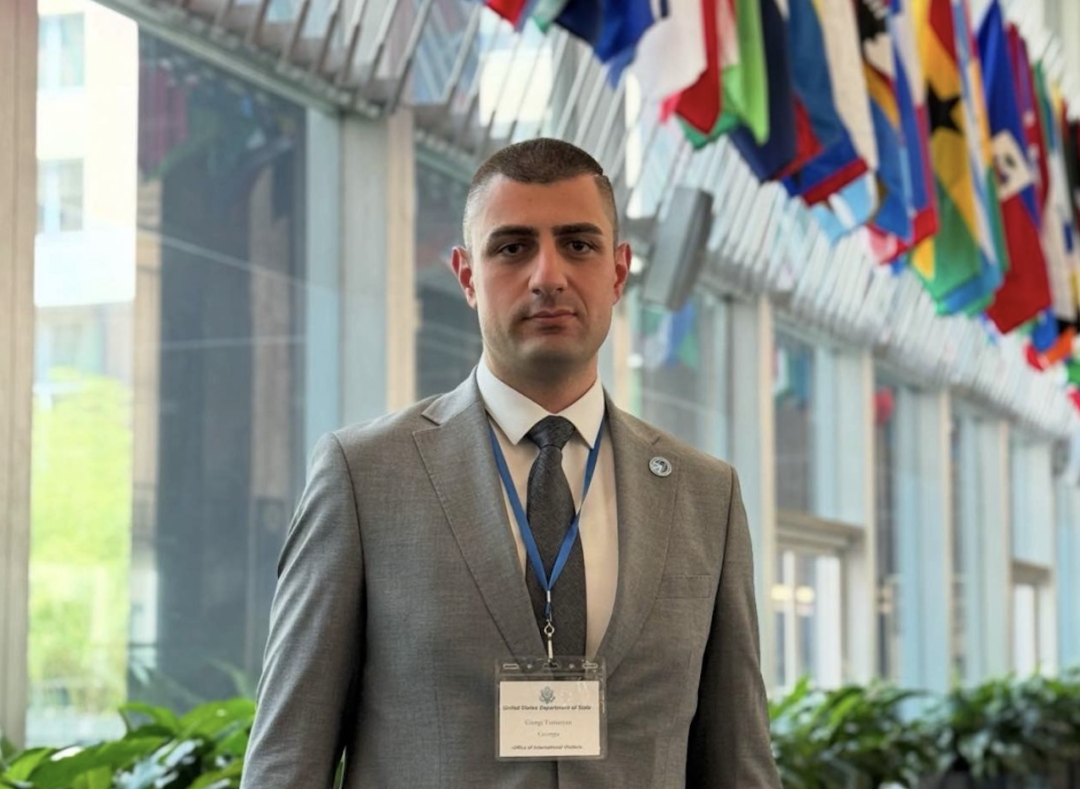
Giorgi Tumasyan: Tbilisi and Yerevan Can Jointly Tackle Geopolitical Challenges
The South Caucasus is undergoing a period of rapid geopolitical resets and strategic reshuffling shaped by shifting security order, evolving alliances, and new regional connectivity initiatives. The latter critical developments are prompting governments and regional actors to reassess existing agendas, strengthen partnerships, and navigate emerging uncertainties. In this context, the historically stable yet increasingly strategic relationship between Georgia and Armenia has taken on renewed significance.
This interview features Mr. Giorgi Tumasyan, a diplomat, member of the political initiative “Georgia First,” and Research Fellow at the EU Awareness Centre. Drawing on his expertise, he offers insight into Armenia’s diversification of foreign policy, the evolving strategic ties between Armenia and Georgia, Yerevan’s ongoing peace initiatives and regional positioning, the implications of the TRIPP framework for both states, and the potential consequences of Armenia’s upcoming elections. Together, these topics provide a comprehensive look at the developments and dynamics transforming the region today.
In the light of Armenia’s evolving security environment and its recent decisions that diverge from Moscow’s expectations, how do you interpret the current state of Armenia–Russia relations, and what signals should regional actors, particularly Georgia, take from this recalibration?
The current stance of Armenia in relations with Russia is based on pragmatism and realism, or as it is called in Armenia, “the policy of balance and balancing”. Armenia has almost completely redirected its military purchases from Russia to other partners, mainly the United States, France, and India, reducing the level of dependence on Russia from about 90% to under 10%. Meanwhile, Armenia’s membership in the CSTO and bilateral military ties with Russia are de facto frozen by Yerevan’s unilateral decision. Additionally, Armenia has decreased Russia’s border guard presence at its borders and is aiming at their complete removal while maintaining economic cooperation and avoiding direct confrontations with Moscow.
For Georgia, this situation has become increasingly important. Russia’s stance towards Armenia, which forced Armenia, Russia’s former closest ally, to seek alliances with the West, demonstrated Moscow’s complete unreliability as a partner or ally. Moreover, Russia continues to undermine the statehood of its so-called partner. On the other hand, Armenia is removing Russia’s presence from Georgia’s back, which was a key foreign and security priority for Georgia when I was accepted to the Diplomatic Reserve of the MFA of Georgia in 2017, and I believe it remains so.
Armenia has been visibly diversifying its foreign policy partnerships in recent years. What core strategic calculations are driving this shift, and how is Yerevan balancing the pursuit of new alignments with the realities of its longstanding security and economic dependencies?
The primary calculation is based on the experience of the failed security system that relied fully on Russia. This was evident during and after the second Karabakh war, as well as later during Azerbaijan’s attack and occupation of Armenia’s sovereign and internationally recognized territories. Consequently, Yerevan no longer has the option of full dependency on a single geopolitical center. Diversifying its ties is perceived as diversifying its risks. While Armenia is attempting to eliminate any potential conflicts in its neighborhood with Türkiye and Azerbaijan, it is also seeking strategic partners not only in democratic countries such as the U.S., the U.K., and E.U. countries, but also through a multidirectional foreign policy with new partnerships within the Organization of Turkic States in Central Asia, Iran, China, Arab countries, and other geopolitical centers.
Armenia–Georgia relations have generally remained constructive despite regional volatility. From your perspective, what are the most promising areas for bilateral cooperation today, and where do you see unresolved sensitivities that still require careful diplomatic management?
The relations remain constructive due to numerous layers of connections, but challenges persist due to Georgia’s anti-Western and increasingly pro-Russian stance. For Yerevan, it’s evident that Georgia’s de facto partial economic embargo (on numerous products since spring 2025) and almost complete military embargo (French military supply through Georgia is halted since 2024) are a result of Russia’s growing influence over Georgia. Furthermore, Armenia’s decision to pursue EU integration was influenced by Georgia’s candidate status, heavily lobbied by Prime Minister Pashinyan with his French counterpart Macron. However, Georgia deliberately undermined the EU integration process, making the trilateral Armenia-EU-US Brussels decisions of April 2024 nearly impossible to implement. This was because the implementation was supposed to occur through Georgia’s territory as a country with EU candidate status, which Georgia itself halted first de facto, then by a 28 November 2024 statement which triggered mass protests which last till today and is one of the longest in history of protest either in Georgia or elsewhere, and in when April 2024, Georgia’s de facto ruler, Ivanishvili, declared that the EU is the “global war party.” For Armenia, it’s clear that Russia’s actions, using Georgia as a tool, are aimed at preventing both Georgia’s and Armenia’s European integration, thereby leaving Russia’s sphere of influence.
Yerevan has positioned itself as a proponent of regional peace initiatives following major geopolitical upheavals. How do you assess the credibility and sustainability of Armenia’s current peace agenda, and what external or internal factors most strongly influence its direction?
Armenia’s current peace agenda is increasingly credible and sustainable, especially after the 8 August 2025 Washington trilateral agreements, but still relies heavily on the outcomes of the upcoming major parliamentary elections in Armenia in June 2026. For the agenda to become irreversible, the ruling party of Civil Contract, led by Prime Minister Pashinyan, needs to guarantee a mandate for another term, which has increasingly more chances with the practical outcomes of the peace process, both in the peaceful situation on the border with Azerbaijan as well as in economic and other ties. Constructive positions and steps of Azerbaijan and Türkiye are essential for the sustainability of the peace agenda, and that includes such sensitive topics as the release of persons of Armenian origin kept by Baku.
The TRIPP initiative has generated new opportunities for connectivity across the region. What strategic value does this project hold for Armenia, and how might its implementation affect economic or political ties with Georgia?
The TRIPP project positions Armenia as a crucial pillar of the East-West logistical ties in the broader Eurasian region. It opens up opportunities for Armenia to emerge as a genuine crossroads of peace, which is literally the name of Armenia’s state program that includes TRIPP. This initiative fosters the creation of mutually beneficial dependencies with neighboring countries, contributing to long-term peace and stability, as well as economic advantages for the entire region. Armenia aims at becoming a partner rather than an obstacle to the actively developing organization of Turkic states. The recent strategic partnership between Armenia and Kazakhstan serves as a testament to this.
Conversely, Georgia is losing its influence and monopoly over logistics in the Middle Corridor due to the anti-Western and anti-democratic policies of its ruling party. This has led to strained relations with Azerbaijan and Armenia, as evidenced by Azerbaijan’s state-affiliated media articles. Additionally, Georgia’s decision to provide key infrastructure to the Chinese Communist Party instead of the United States, as seen in the case of U.S. led TRIPP by Armenia, further exacerbates these issues.
The potential for Georgia to change its political leadership and rebuild trust with Washington, London, and Brussels presents a genuine opportunity. By conditionally balancing its foreign policy with other geopolitical centers, including its close neighbors as well as China and Russia, Georgia can seize the chance to not miss out on the vast possibilities that lie ahead. This includes becoming a joint partner with Armenia in the new reshaping of regional connectivity and the economy. The political initiative “Georgia First,” which I represent, is precisely the team of statesmen that can achieve this.
As Armenia approaches its upcoming elections, what are the key domestic debates shaping the political landscape, and how might different electoral outcomes influence the country’s foreign policy trajectory and regional engagement?
Key domestic debates revolve around relations with Azerbaijan and Turkey, particularly the Karabakh conflict and Russia. The ruling Civil Contract, led by Prime Minister Pashinyan, envisions a future free from conflict and focused on the sovereignty of the Armenian state. However, much of the opposition remains influenced by Russia, speculating on the Karabakh conflict, questioning the TRIPP and Washington agreements, and some are harboring a hidden agenda of rejoining Russia’s sphere of influence, either by joining the Russia-Belarus common state or directly the Russian Federation due to security threats from neighboring countries. The topic of Russia’s influence and control over the Armenian Church remains a crucial aspect of the preelection debate and process. Effectively removing the current leadership of the Church would significantly reduce Russia’s influence over Armenia.
Given the rapid shifts in the South Caucasus geopolitical environment, what long-term vision should Armenia pursue to secure stability, deepen cooperation with neighbors, and maintain strategic flexibility in an increasingly multipolar regional system?
Armenia’s long-term vision for democratic development, economic partnership, and strategic alignment with the United States and European Union should be grounded in pragmatism in decisions and foreign policy. This involves addressing the underdevelopment of economic interdependency and creating new logistical and other mechanisms to balance interests in the region. For Armenia, becoming the strategic political, military, and economically (Major Non-NATO Ally) of the United States (like Israel) in the broader Eastern Europe and Middle East is a fundamental national objective. Meanwhile, further integration with the European Union is now supported not only by Armenia’s law on EU integration adopted recently but also in the EU-Armenia Strategic Partnership Agenda. While becoming strategic partners with Germany on 9 December 2025 and a few weeks before that with the United Kingdom, Armenia still needs to formally become a strategic ally of France, a long-awaited goal which requires formally leaving the Russia-led CSTO.
I firmly believe that a truly sovereign Armenia and a truly sovereign Georgia are crucial pillars of security for both nations. By becoming closest allies, Tbilisi and Yerevan can effectively tackle the challenges posed by various geopolitical actors. They can leverage each other’s strengths while mitigating vulnerabilities. This unique opportunity is equally important and needed at this crucial geopolitical time of turbulence for both nations. I am confident that the Armenian government understands this, while Georgia requires a political change to be prepared for it.
Interview conducted by Luka Okropirashvili for Caucasus Watch
Interviews,
Politics,
Armenia, Azerbaijan, Georgia |
EU, China, South Caucasus, Russia, USA, CSTO, Middle Corridor, TRIPP, Luka Okropirashvili, Giorgi Tumasyan