
Nikoloz Khatiashvili: The Political Trust In Georgia Has Gone Down
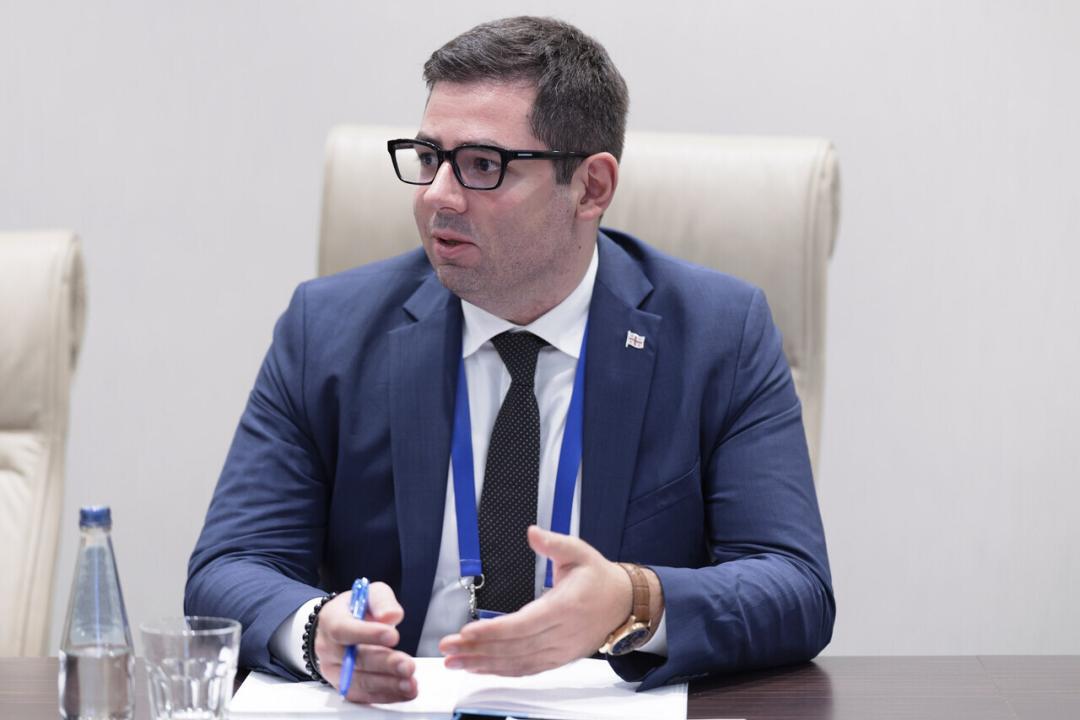
Georgia’s foreign policy is navigating a moment of intense pressure and swift transformation. Its diplomats operate under increased scrutiny, both at home and abroad, as Western partners condition engagement on democratic standards, while regional rivals advance competing agendas. Decisions on alliances, transit corridors, and multivector cooperation now carry immediate consequences for the country’s security, economic opportunities, and international credibility.
This interview features Nikoloz Khatiashvili, Senior Research Fellow at GEOCASE, member of the “Georgia First” initiative, and former diplomat. Drawing on his professional experience within Georgia’s foreign service and his current analytical work, he offers a detailed assessment of the evolving role of Georgian diplomacy under the Georgian Dream government, the shifting attitudes of Western partners, and the broader implications of democratic backsliding for the country’s Euro-Atlantic trajectory. The conversation also examines Georgia’s engagement with alternative Eurasian frameworks, the activation of the OSCE Moscow Mechanism, and the geopolitical significance of Tbilisi’s absence from key international platforms such as Davos. Taken together, these issues offer a thorough and measured assessment of the strategic dilemmas and critical decisions shaping Georgia’s foreign policy at a pivotal juncture for the wider region.
What is the overall attitude of Georgian ambassadors and diplomats towards the Georgian Dream's internal and foreign policies?
When speaking about ambassadors and diplomats, the starting point should be their role in a country’s system of governance. In developed, free societies, the core mission of diplomacy is to protect national interests abroad, advance foreign-policy priorities, and deepen international partnerships. Ambassadors, in particular, are expected to operate based on political neutrality, institutional loyalty to the state (not a party), and professional competence. Unfortunately, Georgia’s recent experience increasingly reflects a different picture. Over the past few years, in a number of cases, ambassadorial appointments have appeared to be driven less by merit, impartiality, and diplomatic track record and more by political loyalty and personal commitment to the ruling party. Where this occurs, diplomatic activity can become oriented toward serving party objectives, while broader strategic priorities, such as credibility with partners, long-term national interests, and the professionalism of the foreign service, are pushed into the background.
As a result, Georgia’s diplomatic service has become more politicized. In this environment, I believe a significant number of active diplomats and ambassadors tend to align with, or at least support, Georgian Dream’s domestic and foreign policy line. At the same time, over the last year, we also witnessed public statements by some diplomats criticizing the government’s political decisions. Following subsequent “reorganization” processes, many of those voices were dismissed from their positions. In addition, during the past eighteen months, several ambassadors have resigned voluntarily. By contrast, the majority of former diplomats appear to hold a more critical view. Many of them have expressed negative assessments of Georgian Dream’s internal and foreign policies, warning that politicization, confrontational messaging, and democratic regression weaken Georgia’s international standing and complicate its Euro-Atlantic trajectory.
What is the current attitude towards Georgian diplomats in Western countries?
The EU has said many times that it is lowering the level of political involvement with Tbilisi because of what has been happening in Georgia and what the government has done. This has meant that high-level meetings and contacts have been put on hold or cut back, which Georgian diplomats have noticed more and more in their daily dealings with EU institutions and important member states. Communication between Georgian diplomats and officials in the host country is still going on at the bilateral level, but it is usually happening at a much lower political level than it used to. To put it another way, channels are not completely closed, but the relationship is now handled more carefully and with fewer senior-level interactions. This shows that political trust has gone down, and conditions have become stricter. There are, however, some important exceptions. In a small number of EU member states, especially Hungary and Slovakia, interactions with Georgian officials have mostly continued in a "business as usual" way, with fewer visible political limits than in the EU as a whole. Georgian diplomats work in a situation that is very similar to the one in the United States. The tone and level of access are more like the EU pattern, which means less high-level political engagement and a more careful, conditional approach in official interactions.
Has the current situation in Georgia somehow affected the relations of the Georgian diplomats with diplomats of other countries?
In terms of personal, informal communication, it is difficult for me to speak with certainty. I cannot rule out that some level of direct personal and informal contact still exists between Georgian diplomats and Western senior officials. However, at the official level, the overall atmosphere in the West is broadly negative and noticeably more cautious than in previous years. At the same time, the picture looks different beyond the Euro-Atlantic space. Across parts of Asia, Africa, and South America, the environment is not shaped by the same political and normative concerns that currently dominate Western engagement with Georgia. In many non-Western countries, attitudes toward Georgia and toward Georgian diplomats remain generally positive, and diplomatic interaction often continues without the same level of political sensitivity. While Western official channels are marked by reduced trust and constrained engagement, Georgia’s representatives frequently encounter a more welcoming and pragmatic tone in a number of non-Western capitals.
How have Georgia's strategic Western partners, particularly NATO and the EU, recalibrated their expectations and demands toward the country amid concerns over democratic backsliding and increasingly confrontational rhetoric from the government?
NATO and the EU have changed how they deal with Georgia. Before, the relationship was based on an "integration through encouragement" model. Now, however, it is shaped more and more by clear political conditions: the restoration and deepening of ties depend on concrete steps that show a return to democratic standards and a credible path to reform. The EU still supports Georgia, but it is now more focused on the people. Brussels' main point is that the Georgian Dream's recent actions have hurt Georgia's European path, which has effectively stopped the accession process from moving forward. The EU has also said many times that the door is still open. If Georgia goes back to being a democracy, makes its policies more like those of Europe, and shows real political will, integration can start up again, and relations can get back to where they were before. But the most important thing is not words, but actions that can be measured. NATO's stance is a little different. The Alliance still has an open-door policy, and there is still some practical cooperation in a few areas. But NATO's messages have become clearer about how Georgia's ability to be a credible and deep partner depends on its ability to uphold democratic governance, the rule of law, ongoing reforms, and a free political environment. So, working together is still possible, but how well the relationship works strategically depends more on what happens in Georgia.
How does the Georgian Dream government now position itself toward these Western actors while continuing to claim commitment to Euro-Atlantic integration?
European and Euro-Atlantic integration is, at its core, a process in which a country implements reforms and progressively aligns with the standards that prevail in EU member states. Those standards have both a technical dimension, which covers institutions, regulations, and governance capacity, and a values-based dimension rooted in freedom, democracy, and the rule of law. Today, we increasingly observe that Georgian Dream is pursuing a dual-track approach toward the European Union. On the one hand, in official statements, senior politicians and government representatives continue to affirm that EU integration remains a national priority. On the other hand, their actions and often their rhetoric move in a markedly different direction, both in terms of reform performance and political messaging.
At times, the government communicates that “Europe is Georgia’s future,” yet soon after, it amplifies claims that the EU threatens Georgia’s sovereignty and that “European bureaucracy” represents a source of pressure or “blackmail” aimed at destabilizing the country. Alongside this, Georgian Dream frequently opts for selective cooperation. It keeps technical channels open and preserves those areas of security cooperation that help maintain domestic legitimacy and a minimum level of international engagement, while politically shifting toward confrontation.
How do you assess the risks and opportunities of Georgia's growing engagement with alternative Eurasian frameworks and non-aligned actors?
For a small country like Georgia, pursuing a balanced, flexible, and pragmatic foreign policy is essential, where international cooperation is a central pillar. This implies a genuinely multivector approach, where Georgia is able to find common ground with a wide range of actors. Crucially, however, such a policy should operate under clear conditions: European and Euro-Atlantic integration must remain the main and priority vector, while cooperation with other partners should be firm, constructive, and designed in a way that does not undermine the Western track.
Georgia should continue its integration processes with the EU and benefit from them, while simultaneously deepening ties with other regions of the world, such as Asia, the Middle East, Africa, Latin America, Oceania, and Australia, to unlock existing potential, but not at the expense of Georgia’s European choice. This approach would increase Georgia’s economic and political flexibility and would be grounded in a realist logic. The primary reference point should be Georgia’s national interests first, and everything else second. Ultimately, all these vectors should serve one overarching goal: strengthening the Georgian state, protecting it from Russian influence, increasing national resilience in the face of threats, and advancing core national interests.
Personally, I see nothing inherently problematic in closer engagement with the broader Eurasian space, provided it occurs in parallel with, not instead of, integration with the West. Unfortunately, today we see a stalled Western integration process alongside active engagement with Eurasian and Middle Eastern partners, which on its own cannot be sufficient to ensure Georgia’s development and security.
On the opportunity side, economic diversification and the realization of Georgia’s transit potential through the “Middle Corridor”, including infrastructure projects, port and railway development, undersea cables, logistics, and new digital corridors, could increase revenues, strengthen Georgia’s regional role, and deepen connectivity between Europe and Asia. This may even contribute to additional security guarantees. Yet implementing this agenda requires close ties with the West and a high level of trust. The risks are equally clear. If the Asian vector begins to strategically replace the Western one, it will accelerate Georgia’s distancing from its key partners. Substituting Western financial systems and technologies with alternatives from the East could also increase vulnerability and hand external actors new political and economic leverage over Georgia, an outcome that would pose a serious strategic challenge and threat.
Several OSCE participating states have activated the Moscow Mechanism with regard to Georgia. From your perspective, how should this signaling move be interpreted in political and institutional terms within the OSCE framework?
The activation of the OSCE Moscow Mechanism can be understood as a strong political signal from participating states that they see serious, systemic problems in the country related to human rights and democratic governance, and such routine dialogue and standard procedures are no longer considered sufficient.
Significantly, the Moscow Mechanism was triggered after the Vienna Mechanism had already been used. This sequencing suggests that the Vienna Mechanism, which is designed to seek clarification through questions and official exchanges, failed to alleviate participating states’ concerns or dispel doubts about the situation on the ground.
Politically, the Moscow Mechanism functions as a tool of naming, scrutiny, and accountability. It increases the reputational costs for the government, elevates international attention, and simultaneously sends a message to Georgian society and civil actors that democratic problems within the OSCE area are treated as a matter of shared security and shared commitments.
Institutionally, the mechanism establishes an independent expert mission with a defined mandate, timeline, and thematic scope. Importantly, the mission can proceed even if the state concerned does not fully cooperate. Its typical output is a report containing verified findings and concrete recommendations. This report is then discussed within OSCE bodies, including the Permanent Council, and can serve as a basis for subsequent diplomatic pressure, conditionality, and recalibration of assistance. Even if the report is not formally “endorsed” by consensus, because some participating states may veto it, its practical impact can still be substantial. Such a document often serves as a key reference point for international organizations and individual governments during their decision-making and actions towards the country concerned. In this sense, the Moscow Mechanism is both a warning reflecting a deficit of trust and a procedural pathway for the OSCE to produce a credible, documented assessment and articulate specific expectations.
Georgia was not represented at the recent World Economic Forum in Davos, while Armenia and Azerbaijan presented themselves as initiators of a new South Caucasus centered on connectivity and strategic relevance. This followed recent tensions involving Georgia, Armenia, and Azerbaijan over regional transit issues. How should Georgia’s absence be understood in this broader regional and geopolitical context?
Unfortunately, Georgia's delegation has missed the World Economic Forum for the second year in a row. Presence is especially important right now because major processes are unfolding in the South Caucasus, like the TRIPP corridor and other regional connectivity projects moving forward, and the U.S. is getting more involved in the region.
Davos is a one-of-a-kind place where government and business leaders discuss investment opportunities, form partnerships, and, most importantly, build informal ways to talk to each other that are just as important as formal diplomacy. A lot of people know that these off-the-record talks and networks of trust often lead to big changes, such as getting considerable Western resources or opening the door to strategic cooperation.
Against this backdrop, Armenia and Azerbaijan used Davos to project a narrative that a “new order” in the South Caucasus can be built around connectivity, a peace agenda, and competition among transit corridors. Importantly, the message was also voiced implicitly and at times explicitly that future bilateral trade could develop in ways that reduce reliance on Georgian transit routes. For Georgia, this is a strategic challenge because its traditional role as the region’s primary gateway between Asia and European markets is a key source of leverage.
The recent tensions with Azerbaijan over transit issues only amplify the costs of Georgia’s absence. In such circumstances, not being present in Davos is even more damaging. Georgia loses the opportunity to defend its reputation as a reliable transit hub, to advocate for investment in the Middle Corridor, and to reassure partners that it remains the most stable and secure Black Sea anchor in the region.
Georgia’s non-participation can therefore be interpreted as a combination of factors, such as a more cautious Western posture toward the Georgian government, reduced political trust, and another missed high-level platform, one that carried tangible diplomatic and economic opportunities.
Interview conducted by Luka Okropirashvili for Caucasus Watch
Interviews,
Politics,
Georgia |
NATO, USA, Georgian Dream, Davos, TRIPP, Geocase, Luka Okropirashvili, Nikoloz Khatiashvili