
Swasti Rao: What Can Armenia Learn from Kashmir?
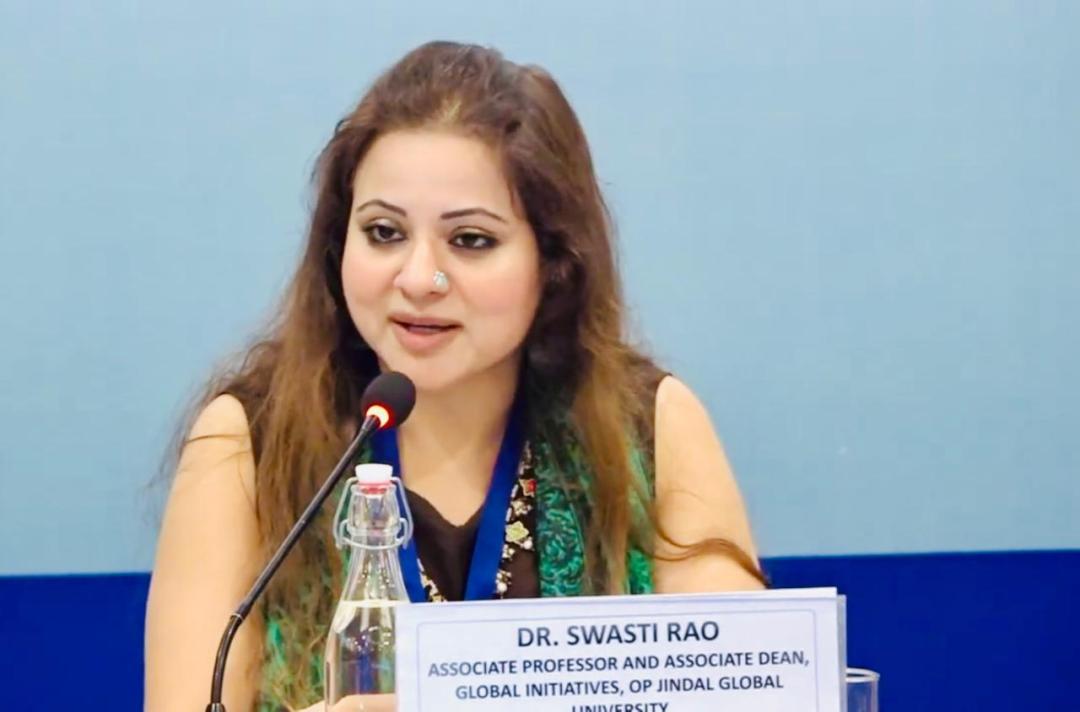
Operation Sindoor gained global attention. From an Indian perspective, it was a military and geopolitical watershed moment. Launched in May 2025 following the Pahalgam terror attack, it was India’s first multi-domain offensive explicitly acknowledged by the government. The whole world watched a display of air superiority, air defence, electronic warfare, and strategic communication. Numerous systems were put to the test, many of which have been procured by Armenia. The question then is: what can Armenia learn from this campaign? To address the question at hand, we reached out to Professor Swasti Rao.
Professor Swasti Rao is an Associate Professor of International Relations and Security at Jindal Global University, a Consulting Editor for International and Strategic Affairs at The Print, and a Defence Consultant at the Ministry of Defence in India. Caucasus Watch met her at the Yerevan Dialogue (26-27 May), organised by the foreign ministry. Initially, our interview focus was on ‘lessons learned’ for Armenia from the conflict in Kashmir, as the South Caucasus country is reliant on Indian defence platforms. The subsequent conflict in Iran adds another layer of interest to this discussion, as landlocked Armenia and India are major stakeholders in Iran's strategic geography.
During the conflict between India and Pakistan over Kashmir, your air denial systems appeared effective. Pakistani planes mainly operated from their own airspace. Given Armenia's small territory, could the country rely on Indian systems to build area denial, despite the perceived asymmetry with Azerbaijan?
The first thing to understand is that India operates a multi-layered air defence. In the case of Operation Sindoor, India used a range of systems, including indigenous systems sold to Armenia. Armenia has been buying the whole range of systems we develop indigenously. Therefore, there is a compelling case for Armenia to view this conflict as a relevant precedent.
Air defence has several layers. India has not developed an indigenous long-range surface-to-air system. S-400 Russian systems cover our outer layer. However, indigenous Indian systems proved effective in medium-range defence. I am referring specifically to the L/70 40mm anti-aircraft autocannons. We also used the Osa-AK Soviet-origin quick-reaction surface-to-air system to protect critical infrastructure and target UAVs and low-flying aircraft. They performed reliably. We also utilised the evolution of the Soviet Shilka air defence system (ZSU-23-4), which proved particularly effective against drones. Perhaps more significantly, we saw the successful and potent deployment of India’s flagship Akash medium-range surface-to-air missile (SAM) system.
So, in Armenia's case, replicating that experience makes sense. The Akash air defences, in combination with the domestically produced L/70 guns, can provide Armenia with a sufficient umbrella. This view is echoed in the various discussions we continue to have with the aviation community here. This is not just my view, but also the shared perspective of the Indian aviation community and the Indian military aviation committee.
The catch is that to create these layers, the discussion has to go beyond systems. One needs to discuss radars and sensors, some of which we do export to Armenia. We need to mention, in particular, the Swathi Weapon Locating Radar (WLR) and the Rohini 3D medium-range surveillance radar. The combination of missile and radar systems to which Armenia has access presents a solid air defence proposition, if complemented with corresponding sensors. The trick, of course, is system integration. However, Armenia has much to learn from Operation Sindoor, and the lessons can be replicated.
Operation Sindoor is the biggest jet-fighter battle of modern times. Azerbaijan has procured the hybrid J-17 jet fighters, integrating indigenous, Turkish, and Chinese technological elements. How did this platform perform?
There has been a perception in the Indian military community that the quality of Chinese systems is subpar. These perceptions come from open-source reports discussing the performance of the J-17, stating that it is "no good," etc. I would beg to differ. Frankly, the platforms demonstrate a formidable array of air-to-ground and air-to-air payloads. They are pretty good.
However, if Armenia is able to procure the Tejas Mk2 (Mark Two) platform, it could counterbalance the J-17s. The specifications of the Indian platform more than match those of the J-17. The only question is time. Frankly, our indigenous production has been delayed, and India is in a tight spot, as we depend on imports and face delivery backlogs. From the moment you place an order, you may have to wait three to six years. In the context of Armenia, I would say that whenever the time is right—considering the process of normalisation between Azerbaijan and Armenia—Armenia needs to make a balancing move. We expect it to be available by 2030, possibly as early as 2028 in the best-case scenario.
However, we don't have anything to offer Armenia right now, but if the timing can be managed without obstructing normalisation, then there is a real prospect. Forty years ago, Hindustan Aeronautics Limited decided to develop its indigenous fighter jet program. The LCA program was divided into different variants, all dependent on GE engines. The first one was called the LCA Mark 1, and we have produced 40 aircraft. There were 20 of the Initial Operating Capability (IOC) and 20 of the Full Operational Capability (FOC). These were inducted into the Indian Air Force.
The performance of the IOC variety is not where it needs to be. The program was delayed by 20 years, and the aviation community was flabbergasted, pressuring for timely delivery. The next variant of the Tejas was to be the Tejas Mark 1A, but right now the government is likely to prefer the more advanced Mark 2 variant of the platform, which still has an American engine (GE414). We are trying to develop our own engine (Kaveri), but so far, the "dry" Kaveri is only appropriate for drones, not jet fighters.
In parallel, India is aspiring to develop the Advanced Medium Combat Aircraft (AMCA), a fifth-generation fighter jet. While the initial prototypes of AMCA will also have the GE414 engine, we are looking to deepen cooperation with a foreign partner—most likely Safran—to develop our indigenous fighter jet engine with a thrust greater than 100 kN. If successful, we would like to lessen our dependence on GE engines.
Will this Tejas platform be affordable for Armenia? The J-17 targets a budget market for 4.5-generation capabilities, such as Myanmar, Uganda, Argentina, Iraq, and Azerbaijan.
The Tejas Mark 2 is going to be our 4.5-generation platform, equivalent to a Rafale, and AMCA is a fifth-generation platform. In terms of price, we are looking at about $70 million each. That is competitive and much cheaper than a Western platform (J-17: $25-30 million, Rafale: $85 million). Of course, the price depends on the volume of the order, as well as the type of sensors and missiles, and any co-production arrangements. Part of the reason Armenia buys Indian systems is that they are cost-effective.
For India, Armenia provides a wonderful showcase for our advanced weapon platforms, but not the ones co-produced with Russia. Beyond Armenia, India has also sold and co-produced systems such as the BrahMos supersonic cruise missiles to the Philippines, and a deal with Vietnam is being finalised. A few days ago, the Prime Minister went to Cyprus to discuss strategic cooperation. The Indian Ministry of Defence has a stated objective of emerging as a net weapons exporter. I am of the opinion that by entering the niche market of smaller states that require advanced, cost-effective platforms, we can also establish joint ventures with Armenia and Cyprus. All those conversations are already happening. The Indian MoD has come up with two flagship defence industrial corridors in two states, where the idea is not just foreign direct investment but also joint ventures.
Cyprus, for instance, recently acquired an Israeli-made Barak MX anti-aircraft system. India may explore co-producing the Barak-8 Long Range Surface-to-Air Missile (LR-SAM) with Cyprus, which we co-produce with Israel. The idea is that India will fill the gap for co-producing cheaper weapons for countries serious about modernisation but on a budget, through innovative joint ventures.
In pursuing this strategy, we are gradually moving away from Russian platforms, even though our dependence on legacy platforms continues. Diversification is particularly true for jet fighters, because many of the Sukhoi series have not performed well in Ukraine. The Rafales are presently the most advanced platforms in our inventory, but we are facing squadron shortages. Therefore, for the years ahead, India must place a strong focus on diplomacy and normalisation. We are not ready for a conflict like Operation Sindoor. Red tape and procurement delays stand in the way of where we need to be.
Let’s move towards current affairs. China and Pakistan have drafted a resolution calling for an immediate ceasefire in the conflict with Iran. India has a special relationship with both Iran and Israel. Where do you see the relationship with Iran going?
For us, Iran is important for three reasons, all of which are related to connectivity. The first point is that we are looking to connect our investments in Iran’s Chabahar port and the International North-South Transport Corridor. Most of our trade is currently dependent on transit via the Suez Canal, which is precarious given the presence of the Houthis. The India-Middle East-Europe Economic Corridor is another alternative route, linking us to Europe via the Middle East, which is now postponed until further notice. So, Iran is necessary for our connectivity.
The second reason focuses on Armenia. The trilateral partnership with Armenia and Iran ensures we can secure military logistics. That is in India’s interest. Iran is currently the primary conduit for our deliveries to Armenia. Given the geography, there could be other alternatives to reaching Armenia, but this is the most reliable route. Additionally, India plays a role in diplomatically supporting Pakistan’s Baloch separatists to counterbalance Islamabad’s influence. For this reason, too, strategic depth in Iran is essential.
The third reason is that Iran allows access to Central Asia that bypasses Pakistan. Iran and Afghanistan are the only direct overland conduits we have. In parallel, we are trying to limit Afghanistan’s reliance on Karachi, ensuring we can still maintain influence in Kabul. Therefore, Iran is crucial for India's strategic depth.
China is attempting to reduce Afghanistan's reliance on Karachi and instead connect it to Gwadar, a key infrastructure hub for the Belt and Road Initiative and the China-Pakistan Economic Corridor. China has outpaced us, so we need to be present in the region via Iran to divert trade to Chabahar and Bandar Abbas and avoid being encircled. Like the rest of the world, we naturally fear the closure of the Strait of Hormuz, which would impact oil prices.
Going full circle to Armenia. Yerevan’s relationship with New Delhi depends on Tehran’s cooperation for transit. Is there a Plan B, given that Georgia has historically blocked arms deliveries and Turkey and Azerbaijan are not likely to oblige? What is a landlocked country to do?
My answer is personal speculation, not information from conversations to which I am not privy. Ideally, the situation in Iran should normalise. Iran’s geography is essential to us, as I mentioned earlier. To answer your question: private Indian industries are selling ammunition to Ukraine via third parties. This might be replicated in Armenia. We can think of the option of using multiple third parties.
Interview conducted by Ilya Roubanis